Wed, September 16, 2026

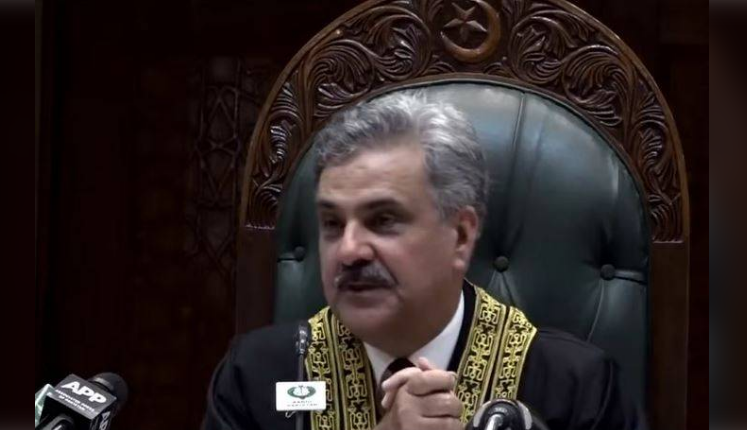
Islamabad (Web Desk): The Supreme Court of Pakistan (SCP) on Monday opened the New Judicial Year 2026-27 with a renewed commitment to speedier justice, better case management, improved services and measurable institutional reform.
Chief Justice of Pakistan (CJP) Justice Yahya Afridi presided over the ceremony which held at the Courtroom No. 1.
The event was attended by all serving Supreme Court judges, Attorney General for Pakistan (AGP), Vice Chairman Pakistan Bar Council (PBC), President Supreme Court Bar Association of Pakistan (SCBAP) and a large number of lawyers and other members of the legal community.
Addressing the gathering, the CJP presented an overview of the top court’s ongoing reform programme, which centres on five broad priorities: using technology to improve service delivery, expanding access and transparency, reinforcing the legal and regulatory structure, making better use of domestic and international resources, and revitalising institutions connected with the justice system.
He said the SC had undertaken 86 reform measures across eight functional areas. Of these, 65 had been completed, eight were progressing according to plan and 13 needed additional attention.
The CJP said that the purpose of these measures was ultimately to improve the quality and delivery of justice, with judicial independence going hand in hand with institutional accountability.
Turning to the top court’s technological development, he said several processes had already been digitised, including the registration and barcoding of pending and newly filed cases. The court had also introduced electronic transmission of orders and judgments, an e-office system, paperless proceedings and e-filing facilities.
The CJP said that the court’s digital agenda would now have to move beyond simply digitising existing processes. The next stage, he explained, would involve creating a connected and interoperable digital justice structure, supported by reliable data systems and stronger cybersecurity.
He also highlighted work on the National Standardised e-filing framework, designed to establish uniform filing procedures for the SC, high courts and district judiciary.
The initiative is intended to make filing easier and provide lawyers and litigants with a more consistent and predictable process.
Provincial bar councils, along with the Islamabad Bar Council, have been engaged in developing the framework, which has subsequently been submitted to the National Judicial (Policy Making) Committee.
On improving public access to the judiciary, the CJP referred to the establishment and expansion of Public Facilitation Centres, digital communication facilities, organised feedback mechanisms and better arrangements for litigants, overseas Pakistanis and members of the media.
He said work on a Public Facilitation Centre at the Lahore Registry was expected to be completed by the middle of November.
The SC has also completed compliance requirements for ISO certification, marking another step towards standardised procedures and improved quality management.
The CJP said that the Access to Justice Development Fund had helped provide courts and Bar rooms throughout the country with uninterrupted electricity or solar power, facilities for women, e-libraries, internet access and safe drinking water.
He added that the programme had been implemented almost completely, with 12 districts in Balochistan still facing delays because security conditions were affecting implementation.
While discussing the SC efforts to tackle its backlog, the CJP reported considerable progress in several priority categories of cases.
He said death sentence appeals had been brought forward from cases dating back to 2015 through 2026. A total of 613 appeals had been decided, leaving 31 cases from 2026 still pending.
In cases regarding bail before arrest, the top court had cleared matters dating from 2016 to 2026, disposing of 2,972 petitions and leaving 115 cases from 2026.
For bail after arrest, the court had worked through cases dating from 2009 to 2026, deciding 2,926 petitions and leaving 185 cases from 2026.
In family-related litigation, cases dating from 2010 to 2026 had been taken up, with 1,752 matters decided and 369 still pending. Of the remaining cases, 310 were filed in 2026.In taxation cases, the court had dealt with matters dating from 2011 to 2021, deciding 691 cases. Another 1,044 cases remained pending, including 876 matters instituted during 2025 and 2026.
The backlog in rent cases had been reduced to 133, comprising 23 cases from 2025 and 110 from 2026. In service matters, 4,302 cases had been disposed of, while 3,660 remained pending, including 2,115 cases filed during 2025 and 2026.
The CJP said that successful case management depended on effective coordination between the Court Office, the Bench and the Bar.
He particularly stressed the importance of correctly categorising cases, fixing matters without unnecessary delay, managing hearings effectively and avoiding adjournments that serve no useful purpose.
The CJP pointed to several measures adopted by the SC, including the fixation of 40 per cent of old cases, removal of discretionary out-of-turn fixation and the disposal of 202 cases in a single day and the daily presence of the Registrar at the Public Facilitation Centre at 11:00 am for redressal of grievances.
He added that benches were also being organised according to different categories, including time-sensitive and early-hearing matters as well as corporate, commercial, fiscal, civil, service and labour cases.
The purpose is to ensure that cases receive attention based on their character, urgency and priority.
He also called attention to mediation and Alternative Dispute Resolution (ADR), saying that a dispute does not always have to end with a formal judicial verdictWhere appropriate, court-annexed mediation can provide litigants with a quicker, fair and effective avenue for settling their disagreements.
The CJP further highlighted the SC’s expanding engagement with foreign judicial institutions. He said memoranda of understanding had been signed with the Supreme People’s Court of China and the Constitutional Court of Türkiye, while additional cooperation was being developed with judicial bodies in Korea, Azerbaijan, Türkiye, the United Kingdom (UK), Russia, Singapore, Malaysia and the United States (US).
Under these international programmes, four technical officers had travelled to Türkiye and five to China. In addition, 12 judicial officers from the District Judiciary had visited Türkiye, while 31 had travelled to China for professional training and exposure.
The Attorney General for Pakistan (AGP) praised the CJP and the SC judges for their efforts to reduce the accumulation of pending cases and modernise the country’s judicial system.
He specifically appreciated progress in case management, digitisation, e-filing, video-link hearings, public facilitation, prison reforms and ADR, while urging the judiciary to maintain its efforts towards delivering timely and effective justice.
Pakistan Bar Council Vice Chairman Pir Muhammad Masood Chishti also welcomed the improvements made in case management, e-filing, public facilitation, video-link facilities and the reduction of pending cases.
He stressed the need for speedy justice, greater reliance on ADR and a constructive relationship between the Bench and Bar.
SCBA President Haroon-ur-Rashid likewise praised the introduction of facilitation centres, e-filing services, digitisation and improved case management.
He said that technological and institutional changes would only achieve their true purpose if they resulted in justice that was timely, affordable and effective for ordinary litigants.
Concluding his address, CJP Justice Yahya Afridi called for the New Judicial Year 2026-27 to be marked by better case management, better services, greater predictability and measurable institutional improvement.
The CJP emphasised that the true measure of the judiciary lies in the trust it commands, the fairness it upholds, and the assurance it gives every citizen that they will be heard, treated with dignity and given justice.
Neo News | Copyright © 2026