Thu, September 17, 2026

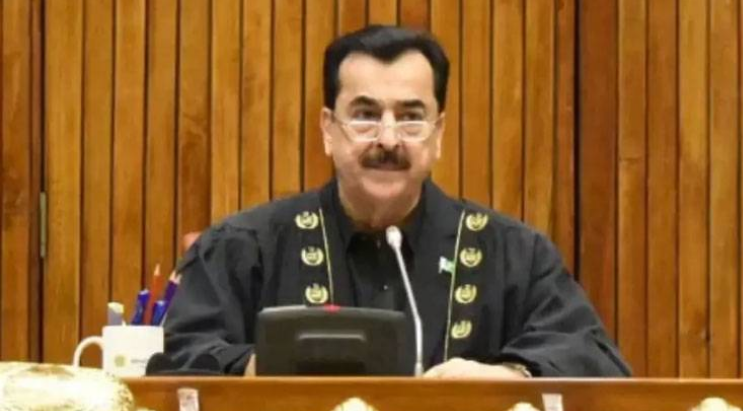
Islamabad (Web Desk): The Senate on Friday approved four key pieces of legislation, including amendments to the Pakistan Army, Air Force and Navy Acts for 2025, as well as changes to the Supreme Court Practice and Procedure law.
Deputy Prime Minister and Foreign Minister Mohammad Ishaq Dar, representing Defence Minister Khawaja Muhammad Asif, presented the Pakistan Army Act (Amendment) Bill 2025 and the Pakistan Air Force (Amendment) Bill 2025, both of which had already cleared the National Assembly.
Khawaja Asif himself introduced the Pakistan Navy (Amendment) Bill 2025, while Minister for Parliamentary Affairs Dr Tariq Fazal Chaudhary tabled the Supreme Court Practice and Procedure (Amendment) Bill 2025 on behalf of the law minister.
The Pakistan Army (Amendment) Bill proposes several significant changes, including replacing the title of “chief of the army staff” with “chief of the defence forces” (CDF) in accordance with the 27th Constitutional Amendment.
It also seeks to substitute the position of “Chairman Joint Chiefs of Staff Committee” with a newly designated “commander of the National Strategic Command.”
An additional adjustment to Section 8A of the Pakistan Army Act 1952 clarifies that the tenure of the first officer appointed as chief of the army staff who will concurrently serve as the chief of the defence forces will begin from the date on which the office is officially notified.
Another amendment outlines the process for appointing the commander of the National Strategic Command, authorizing the prime minister—acting on the recommendation of the army chief who will also hold the CDF role—to select a commander from among the Pakistan Army’s generals for a three-year term.
The legislation further specifies that Article 243 provisions applicable to a Field Marshal will extend to any General elevated to that rank. It also allows the federal government to empower the Vice Chief of Army Staff or Deputy Chief of Army Staff to exercise the authority of the COAS through written directives issued on the recommendation of the CDF.
A major organisational shift endorsed in the bill is the dissolution of the office of Chairman Joint Chiefs of Staff Committee (CJCSC), which will be replaced by the Commander of the National Strategic Command.
The prime minister will appoint this commander from serving generals for a three-year term, based on the COAS/CDF’s advice.
The law grants the premier the right to determine the terms and conditions of this appointment and to approve an additional three-year extension when justified by national security considerations. The bill further stipulates that any appointment, reappointment, or extension for the post cannot be challenged in court.
The Pakistan Air Force (Amendment) Bill 2025 removes sections 10D, 10E, and 10F from the Pakistan Air Force Act, which previously concerned the appointment of the PAF chief as CJCSC along with matters relating to tenure, extension, and retirement. All references to the CJCSC have been eliminated throughout the Act.
Similarly, the Pakistan Navy (Amendment) Bill 2025 omits sections 14D, 14E, and 14F from the Pakistan Navy Act, which earlier governed the appointment and tenure of the naval chief in relation to the CJCSC role.
The Senate also given its approval to the Supreme Court (Practice and Procedure) Bill, 2025, which introduces a fresh framework for how benches of the Supreme Court will be formed. According to the bill, all types of cases—whether petitions, appeals, or review pleas—will be taken up by benches put together by a committee that includes the chief justice, the second most senior judge, and a judge selected by the chief justice.
The legislation also clarifies that if any member of this committee cannot attend a meeting, the chief justice will have the authority to appoint another judge in their place.
Moreover, the bill removes the sections referencing “Constitutional Benches” that were part of the Supreme Court (Practice and Procedure) Act, 2023 (XVII of 2023) under the 26th Amendment.
Neo News | Copyright © 2026