Thu, September 17, 2026

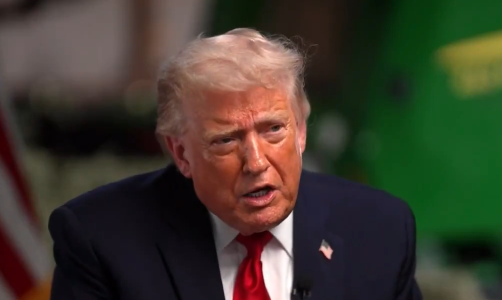
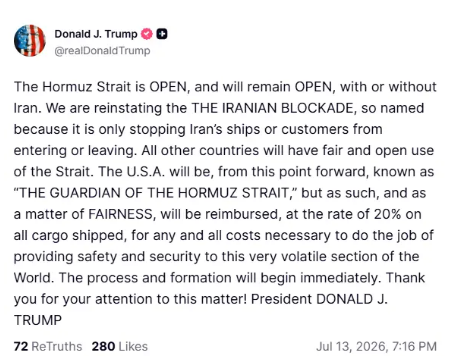
Washington (Web Desk): US President Donald Trump has unveiled a new policy for the Strait of Hormuz, announcing that Iranian vessels will be barred from the strategic waterway while cargo ships from other countries will be required to pay a 20 percent transit fee.
In a post on his social media platform, Trump declared that the United States would serve as the "guardian of the Strait of Hormuz." He said the restrictions would apply to Iranian ships and vessels linked to Iran, while commercial ships from other nations would continue to pass through the strait after paying the newly introduced charge.
According to Trump, the 20 percent fee will apply to all cargo transported through the waterway, with the policy set to take effect immediately.
The announcement follows Trump's earlier remarks in which he suggested that Washington could eventually assume control of the Strait of Hormuz. During a telephone interview with a US broadcaster, he said, "We are taking control of the Strait of Hormuz. We will be its guardians, and we should be paid for that responsibility."
He further stated, "We are going to keep it secure, and we deserve substantial compensation because many other countries benefit from it. We are not going to do this for free."
The Strait of Hormuz is among the world's most important maritime chokepoints, carrying a significant share of global oil exports. The latest developments have intensified concerns in international energy markets, where fears of supply disruptions have already pushed oil prices higher and renewed worries over inflation.
Relations between Washington and Tehran have deteriorated sharply in recent weeks. The United States has repeatedly accused Iran of threatening commercial shipping and attacking oil tankers in the Gulf, while Iran has rejected the allegations.
Despite an earlier ceasefire understanding, both sides have continued military actions. Washington has launched multiple strikes on Iranian targets, while Tehran says it has responded by targeting US military installations across the region, further deepening the confrontation.
Last week, Iran announced the closure of the Strait of Hormuz, citing what it described as "unauthorised transit." Iranian authorities reiterated on Sunday that the waterway would remain closed until transit permissions are restored under conditions of "peace and stability."
Iran's Foreign Ministry said it is coordinating with Oman to establish a joint mechanism for safe maritime navigation through the strait but claimed US pressure on Muscat has slowed progress.
Reacting to Trump's latest proposal, Iran's Khatam al-Anbiya Central Headquarters, the country's top joint military command, firmly rejected any American role in administering the strategic waterway.
A spokesperson for the headquarters said Iran would not permit US interference in the management of the Strait of Hormuz and warned that any American attempt to exercise authority over the waterway without Tehran's approval would face a strong response.
The Islamic Revolutionary Guard Corps (IRGC) also maintained that normal shipping through the Strait of Hormuz can only resume after the United States ends its military presence in the region. It warned that continued US intervention could have far-reaching consequences for global oil and gas supplies.
Neo News | Copyright © 2026