Thu, September 17, 2026

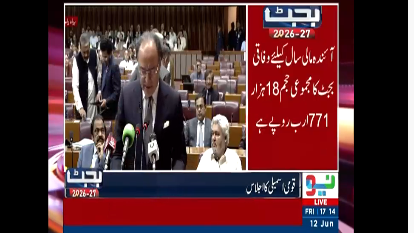
Islamabad (Web Desk): Finance Minister Muhammad Aurangzeb on Friday presented Federal Budget for the Financial Year (FY) 2026-27 with a total outlay of Rs18.7 trillion as the federal government vows to focus on accelerating economic growth and providing tax relief.
Unveiling the budgetary proposals for the next financial year in the National Assembly session in Islamabad, under Speaker Sardar Ayaz Sadiq in chair, the finance minister outlined key economic targets, revenue expectations, and major development priorities for the upcoming fiscal year.
The finance minister said that Rs8,054 billion has been allocated for debt servicing, making it the largest expenditure head of the budget. The government expects total federal revenues of Rs20,600 billion, including Rs15,264 billion in tax collection by the Federal Board of Revenue (FBR), Rs8,848 billion as provincial share, and Rs5,336 billion in non-tax revenues.
The minister projected GDP growth at 4 percent and average inflation at 8.2 percent, while the budget deficit is estimated at 3.6 percent of GDP and a primary surplus of 2 percent.
For development spending, Rs1,000 billion has been allocated under the Federal Public Sector Development Programme (PSDP), while the total national development programme stands at Rs3,675 billion, including provincial development and state-owned enterprise investments.
Defence remains a top priority with Rs3,000 billion allocated, while Rs1,169 billion has been set aside for pensions, Rs1,091 billion for subsidies, and Rs2,680 billion for various grants, including Benazir Income Support Programme (BISP), Azad Jammu and Kashmir (AJK), Gilgit-Baltistan (GB), and newly merged districts of Khyber Pakhtunkhwa (KP)
Civil administration expenses have been estimated at Rs1,071 billion. On social protection, BISP has been allocated Rs838 billion with plans to expand its Kafaalat programme to 12 million families and increase education stipends coverage to 9.2 million children.
Regional allocations include Rs146 billion for AJK, Rs88 billion for Gilgit-Baltistan, and Rs95 billion for merged districts of KP.
The government has prioritised infrastructure development, allocating Rs365 billion for transport projects, including major motorway and highway upgrades, railway expansion, and port development. Key projects include the N-25 highway upgrade, M-6 motorway, Karachi–Rohri corridor, and connectivity improvements for Gwadar.
Energy and water security have also been emphasised, with funds allocated for hydropower projects including Diamer-Bhasha, Tarbela expansion, Mohmand Dam, Dasu, and K-4 water supply project for Karachi. A total of Rs103.1 billion has been set aside for water sector projects.
For urban development and housing, Rs54.6 billion has been allocated to construct affordable and climate-resilient housing units and improve urban infrastructure in major cities.
The IT and export sectors received special attention, with tax concessions extended for IT exports until 2029 and reductions in taxes on export earnings and digital transactions to promote foreign exchange inflows.
Health, education, and youth development were also prioritised, including Rs25.1 billion for health, Rs46 billion for higher education, Rs26.3 billion for schools and colleges, Rs22 billion for Daanish Schools, and Rs7.9 billion for technical training under NAVTTC.
Governance reforms, digitalisation, and institutional improvements have been allocated Rs13 billion.
On relief measures, the government announced a 7 percent increase in salaries and pensions, a 10 percent increase in minimum wage, and significant reductions in income tax rates for salaried individuals across multiple income slabs.
Super tax has been reduced or abolished for various income brackets, while property transaction taxes for filers have also been lowered to encourage construction and economic activity.
Tax on international card transactions has been reduced sharply to promote formal financial channels, while capital value tax on foreign assets has been abolished.
A fixed tax regime has been introduced for small retailers, along with simplified tax returns and QR-based compliance systems.
New excise duties have been imposed on selected imported vehicles and petroleum-based solvents, while concessions on electric vehicles and renewable transport solutions have been maintained.
Custom duties on raw materials used in pharmaceutical production, including cancer medicines, have also been withdrawn to support healthcare manufacturing.
Overall, the budget focuses on balancing fiscal discipline with growth-oriented reforms, increased social spending, and targeted tax relief for households and businesses.
Neo News | Copyright © 2026