Thu, September 17, 2026

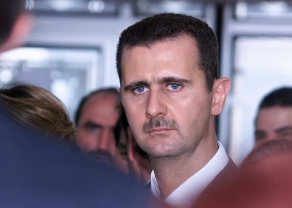
Damascus (Web Desk/Agencies): A Syrian court on Tuesday handed down death sentences to ousted President Bashar al-Assad and two other former regime figures, convicting them in absentia of grave crimes committed during the country’s nearly 14-year conflict, including murder, torture and unlawful detention.
The ruling marks the first conviction issued by a Syrian court against Assad since his government was toppled in December 2024. His removal came after a rapid rebel offensive that brought an end to decades of authoritarian rule by the Assad family and followed years of devastating conflict that claimed hundreds of thousands of lives.
As word of the verdict spread, crowds gathered outside the court in Damascus, where people chanted, applauded and raised Syrian flags in celebration.
Assad escaped Damascus when rebel forces advanced on the capital almost two years ago. He later received asylum in Russia, where he remains with members of his family under humanitarian grounds.
During proceedings against former officials of Assad’s government, the court found the former president guilty of multiple serious offences, including the deliberate killing of more than one person and children, torture, arbitrary detention and crimes against humanity. The judge subsequently imposed the death penalty on him in absentia.
The same punishment was issued against Assad’s brother, Maher al-Assad, the former commander of the powerful Fourth Armoured Division. The unit played a central role in suppressing anti-government demonstrations, recovering territory for Assad’s forces and was also accused of involvement in the manufacture and trafficking of drugs used to generate wealth for the former regime.
Former security official Atef Najib was also sentenced to death. Najib served in the southern province of Deraa, the area where the uprising against Assad first began in 2011.
Najib, who is related to the Assad family, was arrested by Syrian security forces in early 2025. He was the only defendant in the case who appeared before the court in person, while Assad and Maher were tried in absentia.
In Deraa, residents also took to the streets following the verdict. Some carried photographs of relatives and other Syrians who had been detained or killed during the war. Among the images was that of Hamza al-Khatib, a 13-year-old boy whom activists said was taken into custody by Syrian security forces, tortured and later killed.
Noha al-Masri, a prosecutor who attended the sentencing, has a personal connection to the events. Her brother was killed during a crackdown on a protest in Deraa in 2011. Speaking to Reuters, she said the court’s decision reflected the enormous sacrifices made by Syrians and the suffering endured by families who lost loved ones during the conflict.
The verdict came after almost four months of proceedings, which Syria’s new Islamist-led authorities have presented as part of an effort to establish transitional justice and help the country move beyond the Assad era.
However, legal experts have raised concerns that imposing the death penalty could make it even more difficult for Syria to bring Assad and other former officials back to the country.
Anwar al-Bunni, who heads the Syrian Centre for Legal Studies and Research, argued that countries generally would not extradite a suspect to a state where execution could follow.
Bunni told Reuters that the ruling could therefore prevent Assad and other alleged perpetrators from being returned to Syria, describing the proceedings as symbolic rather than genuine transitional justice.
Assad was born in 1965 and assumed Syria’s presidency in 2000 following the death of his father, Hafez al-Assad. He continued his family’s political dominance and maintained the influence of the Alawite community in a country where the majority of the population is Sunni Muslim. Under his leadership, Syria also remained closely aligned with Russia and Iran while maintaining hostile relations with Israel and the United States.
His political career was shaped in part by the Iraq war and Syria’s military involvement in neighbouring Lebanon, but his rule became inseparable from the conflict that erupted after the Arab Spring reached Syria in 2011. Pro-democracy demonstrators took to the streets, and government forces responded with a violent crackdown, eventually turning the unrest into a devastating civil war.
In 2018, then-US President Donald Trump referred to Assad as an “animal” over allegations that his government had used chemical weapons. Assad denied the accusations. Despite early predictions that his government would collapse, he survived years of fighting, even as rebel groups seized large areas of Syrian territory.
The balance of power changed dramatically in 2024 when rebel forces led by Ahmed al-Sharaa, now Syria’s president, launched a swift offensive across the country. The campaign lasted less than two weeks and ultimately forced Assad to abandon the presidency and flee Syria.
Assad is also wanted in France, where authorities have issued an arrest warrant against him in connection with the 2012 bombing of a media centre in Homs.
Neo News | Copyright © 2026