Thu, September 17, 2026

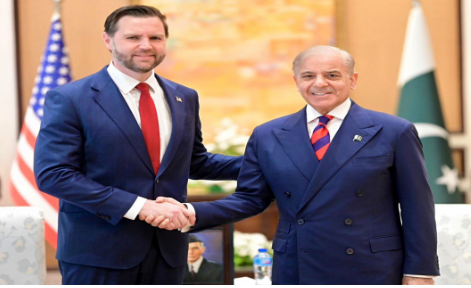
Islamabad (Web Desk): Prime Minister Shehbaz Sharif on Saturday met US Vice President JD Vance who was accompanied by Special Envoy Steve Witkoff and Jared Kushner.
According to a statement issued by the Prime Minister’s Office (PMO), Deputy Prime Minister and Foreign Minister Ishaq Dar and Interior Minister Mohsin Naqvi assisted the premier during the meeting.
“Commending the commitment of both delegations to engage constructively, the prime minister expressed the hope that these talks would serve as a stepping stone toward durable peace in the region,” the statement said adding that PM Shehbaz reiterated Pakistan’s readiness to keep facilitating both sides in advancing progress toward sustainable peace in the region.
Islamabad April 11 ,2026
— Prime Minister's Office (@PakPMO) April 11, 2026
As the Islamabad Talks commenced today, the Prime Minister of Pakistan, Muhammad Shehbaz Sharif held a meeting with His Excellency JD Vance, Vice President of the United States of America.
The U.S. Vice President was assisted by Special Envoy Steve… pic.twitter.com/XcH5x1VlHl
Earlier, the FO stated that the US delegation, led by Vice President JD Vance, arrived in Pakistan to participate in the crucial “Islamabad Talks 2026,” an initiative aimed at advancing a ceasefire between the United States and Iran.
The US delegation includes key Middle East envoys Steve Witkoff and Jared Kushner, both seen as close to Donald Trump.
Upon arrival, they were received by Deputy Prime Minister and Foreign Minister Ishaq Dar, Chief of Defence Forces (CDF) and Chief of Army Staff (COAS) Field Marshal Syed Asim Munir, and Interior Minister Mohsin Naqvi.
US Chargé d’Affaires Natalie Baker was also present at the airport.
Arrival of the US Delegation for Islamabad Talks pic.twitter.com/Hai19EZm4I
— Ministry of Foreign Affairs - Pakistan (@ForeignOfficePk) April 11, 2026
Welcoming the delegation, Dar praised the US for its commitment to promoting long-term regional and global stability.
He expressed hope that all sides would engage in meaningful dialogue and reiterated Pakistan’s willingness to continue facilitating efforts toward a sustainable and lasting resolution.
Before departing for Pakistan, Vance had expressed cautious optimism about the talks, stating that the US was looking forward to constructive negotiations.
He emphasized that progress would depend on Iran’s readiness to engage in good faith, while making it clear that the US team would follow firm guidelines set by the president.
Meanwhile, Iran’s delegation, led by Foreign Minister Abbas Araghchi and Parliament Speaker Mohammad-Bagher Ghalibaf, arrived in Islamabad late Friday night. They were received by DPM Dar, CDF Syed Asim Munir, National Assembly Speaker Sardar Ayaz Sadiq and Interior Minister Mohsin Naqvi.
Pakistan has once again stressed the importance of constructive engagement from both sides.
The talks follow a six-week war between Washington and Tehran that has resulted in thousands of deaths across the Middle East, disrupted global energy supplies, increased inflation, and slowed economic growth worldwide. With both delegations now in Islamabad, there is growing anticipation about the outcome of the negotiations.
Security in Islamabad has been tightened to an unprecedented level ahead of the talks. Key roads have been sealed, security personnel deployed in large numbers, and surveillance measures significantly increased to ensure the safety of visiting delegations.
Officials have confirmed that the negotiations will be held at a secure and undisclosed location away from public and media access.
Pakistan has increasingly positioned itself as a mediator in the crisis. The recent escalation began when the US and Israel carried out airstrikes on Iran, prompting Tehran to retaliate with strikes on Israeli targets and US military bases in the Gulf. In response, Pakistan’s political and military leadership stepped up diplomatic efforts to reduce tensions.
As part of these efforts, Islamabad hosted a quadrilateral meeting involving the foreign ministers of Turkiye, Saudi Arabia, and Egypt, which drew global attention and appreciation.
Pakistan, along with China, also proposed a five-point plan aimed at restoring peace and stability in the Gulf and the wider Middle East.
A fragile ceasefire is currently in place between the US and Iran, based on a two-week ceasefire intended to halt major military actions and reopen critical routes such as the Strait of Hormuz.
Although both sides have portrayed the truce as a form of success, key differences over a long-term agreement remain unresolved.
According to informed sources, JD Vance-led delegation is set to engage with Iranian officials in either direct talks or through mediated, backchannel negotiations.
The discussions are expected to focus primarily on securing a ceasefire in the region, restoring normal shipping operations through the Strait of Hormuz, and facilitating an exchange of prisoners.
During the visit, the US vice president is also scheduled to hold meetings with Pakistani leadership.
International media outlets have begun referring to this diplomatic effort as the “Islamabad Summit 2026.”
Analysts view Vance’s personal participation in the talks as a strong signal of Washington’s seriousness in pursuing a resolution with Iran, suggesting that the US is taking a more committed and proactive approach to addressing tensions in the region this time.
Neo News | Copyright © 2026