Thu, September 17, 2026

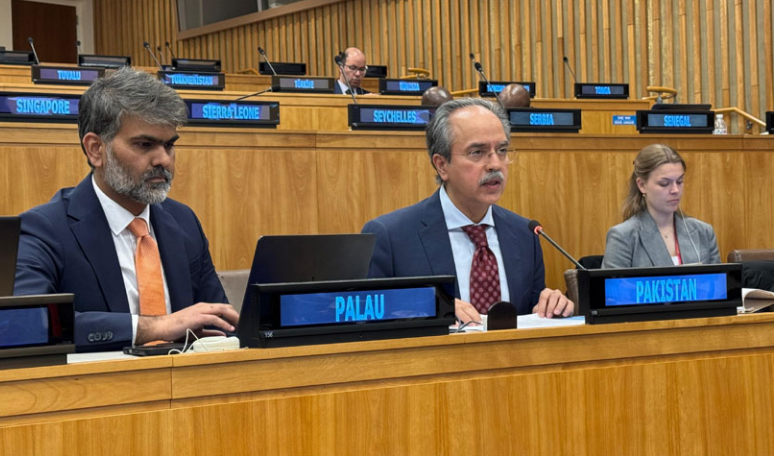
New York (Web Desk/Agencies): Pakistan has drawn the global community’s attention to the increased security threats posed by the proliferation of military Artificial-Intelligence (AI) technologies, particularly autonomous weapons, warning that their use could trigger new arms races and destabilize global and regional security.
During the General Debate of the United Nations (UN) Disarmament Commission 2025, Pakistan’s Permanent Representative to the UN, Ambassador Asim Iftikhar Ahmad, called for urgent action to prevent artificial intelligence from fueling an arms race, which could jeopardize peace and security worldwide.
In his statement, Ambassador Asim emphasized that the military implications of AI are profound and complex, requiring a coordinated, broad-based, and international response.
He argued that the UN must play a central role in addressing the challenges posed by the deployment of AI in the military sector, ensuring that the approach to these issues is inclusive and comprehensive.
Ambassador Asim outlined that the integration of AI into military systems presents a range of challenges—ranging from operational and technical issues to ethical, legal, and normative concerns.
He underscored the importance of ensuring that AI's use in military contexts adheres to International Humanitarian Law.
Moreover, Pakistan’s envoy stressed the need for a unified and collaborative approach, rather than fragmented or selective actions, to address these emerging risks.
In this regard, the UN remains the most appropriate platform for such global discussions, as it ensures legitimacy, fairness, and the involvement of all member states in shaping solutions.
Reflecting on the history of the UN's disarmament efforts, Ambassador Asim pointed out that nuclear disarmament remains a top priority for the organization, dating back to the first Special Session of the General Assembly on Disarmament in 1978.
However, he lamented the lack of substantial progress on nuclear disarmament over the years, even as countries continue to spend large sums on modernizing their nuclear arsenals.
The Pakistani envoy noted that this growing focus on nuclear weapons, alongside increasing global military expenditure, is exacerbating arms races, now accelerated by advancements in technology.
Ambassador Asim expressed Pakistan’s concern over the unequal and discriminatory policies adopted by some countries in the nuclear domain, which have contributed to the worsening of the global security landscape.
He pointed out that geopolitical rivalry and the relentless pursuit of power have led to further fragmentation of international efforts to achieve meaningful disarmament.
These trends, he said, are moving the world farther away from the crucial goal of nuclear disarmament.
In light of these challenges, Ambassador Asim called for a renewed commitment to the core objectives of nuclear disarmament.
He emphasized that this requires fulfilling legal and political obligations, ensuring the security of non-nuclear states from nuclear threats, and creating universal, binding treaties.
Furthermore, he urged for balanced reductions in conventional forces, which are also contributing to rising nuclear risks, and for addressing the underlying causes of arms buildups—such as perceived security threats, power imbalances, and unresolved international conflicts.
Ambassador Asim Iftikhar reaffirmed Pakistan’s dedication to the work of the UN Disarmament Commission, stressing that constructive engagement and collective action are vital to promoting global peace and security in the face of these evolving challenges.
Neo News | Copyright © 2026