Thu, September 17, 2026

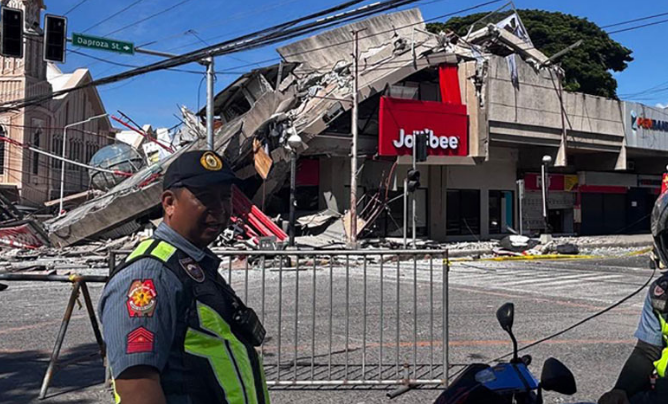
Manila (Web Desk): At least 31 people were feared killed in the southern Philippines on Monday after a powerful magnitude 7.8 earthquake struck offshore near Mindanao, triggering tsunami warnings across multiple countries in Southeast Asia.
The tremor struck in the early morning hours, just as schools were resuming after a long break. Strong shaking was reported across roughly a dozen provinces in the Philippines, while the quake was also felt as far away as Manado city on Indonesia’s Sulawesi island, about 420 km (261 miles) from the epicentre.
Authorities issued tsunami warnings for parts of southern Philippines, northern Indonesia, and Malaysia’s Sabah region on Borneo island after the earthquake, which originated about 20 km (12.4 miles) off the coast of Sarangani province in Mindanao.
Initial casualty reports remained uncertain as officials worked to confirm figures, though the Office of Civil Defence said early information pointed to around 15 deaths and 129 injuries in the affected region, with many victims hurt by falling debris.
President Ferdinand Marcos Jr ordered an immediate large-scale disaster response in Mindanao, directing government agencies to mobilise relief supplies, set up evacuation centres, and prepare rescue teams for deployment. He assured the public that the national government was actively responding and would not abandon those affected in Mindanao.
The Philippines has been repeatedly hit by strong earthquakes in recent years, including a deadly 6.9 magnitude offshore quake near Cebu eight months ago that killed 79 people, followed by two more significant tremors in Mindanao weeks later, the strongest measuring 7.4 magnitude. Both the
Philippines and Indonesia lie along the Pacific Ring of Fire, a highly active seismic zone responsible for frequent earthquakes and volcanic activity.
Seismologists reported at least nine aftershocks following Monday’s main quake across Mindanao, with the strongest reaching magnitude 6.7, adding further concern for already affected communities.
In General Santos city, local footage showed a building housing a fast-food restaurant collapsing, sending crowds running for safety as dust and debris filled the air. Emergency reports also confirmed that a hospital in the city was evacuated after cracks appeared in its upper floors, raising fears of structural instability.
At Notre Dame of Dadiangas University, part of a building gave way during the shaking, though officials confirmed no one was inside at the time. The university president, Manuel de Leon, said he took cover under a table during what he described as a long and intense quake that left people shaken.
In Sarangani province, shops were left with shattered glass, broken signage, and piles of rubble from damaged structures. Philippine military units specialising in disaster response were deployed to assist with rescue operations and provide support in affected areas.
In another incident, a local school captured the moment the earthquake struck, showing children sitting on the floor suddenly swaying violently before teachers rushed them outside as parts of a temporary shelter began to collapse behind them.
Police chief Benjie Ancheta in Alabel town said the quake hit during a flag-raising ceremony, causing panic and even instances of people fainting. He described it as the most powerful earthquake the area had experienced.
International leaders also reacted to the disaster. Malaysian Prime Minister Anwar Ibrahim said his country stood ready to assist the Philippines and expressed prayers and support for those impacted.
The US Tsunami Warning System said several countries could potentially be affected, while Australia initially issued alerts for possible tsunami activity along its northern coastline. Japan’s meteorological agency also released an advisory, reporting a small tsunami of around 0.2 metres and noting minor disruptions such as ferry delays and precautionary beach closures.
In Indonesia, residents in Manado reported feeling strong shaking, though officials said damage appeared limited. Disaster authorities noted that a tsunami wave of up to 0.75 metres was detected in parts of North Sulawesi, prompting some coastal residents to evacuate.
People living in the remote Sangihe Islands also moved to higher ground as a precaution, with residents relocating away from coastal areas due to tsunami concerns.
Authorities across the region continued monitoring conditions closely as aftershocks and tsunami alerts remained in effect.
Neo News | Copyright © 2026