Thu, September 17, 2026

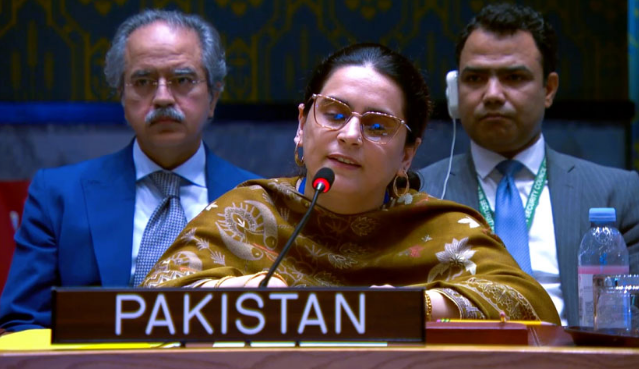
New York (Web Desk): Pakistan has urged the United Nations Security Council to ensure protection for women living under foreign occupation, particularly in Palestine and Kashmir, stressing that their rights must be upheld under international law and that accountability is essential for violations committed against them.
The call came during the Security Council’s annual open debate on the Women, Peace and Security agenda, held on Monday, ahead of the 25th anniversary of Resolution 1325 (2000).
Addressing the session, Pakistan’s representative Saima Saleem described the suffering of Palestinian women as one of the most distressing human tragedies of the present time.
She regretted that the UN Secretary-General’s latest report failed to mention the ongoing ordeal of Kashmiri women, who, she said, have been subjected to sexual violence and other abuses used systematically as instruments of war.
Highlighting the destruction of homes, schools, and maternity hospitals in Gaza, Ms. Saleem said that tens of thousands had been displaced and hundreds of thousands now faced the threat of famine.
These, she declared, “are not incidental misfortunes but deliberate crimes that must be met with justice.”
She pointed out that multiple UN and international human rights mechanisms — including the Office of the High Commissioner for Human Rights, Amnesty International, Human Rights Watch, and Médecins Sans Frontières — have recorded serious violations against women in Indian-occupied Jammu and Kashmir.
These include harassment of female journalists and rights activists, torture, arbitrary detention, reprisals against relatives of the disappeared, and the lasting trauma of sexual abuse.
Ms. Saleem said that excluding Kashmiri women from the global Women, Peace and Security framework “undermines its credibility and universality.” She reminded the Council that the Jammu and Kashmir dispute remains on its formal agenda, urging that future UN reports reflect the situation of Kashmiri women accordingly.
Her strong remarks on India’s human rights record in Kashmir prompted a sharp rebuttal from India’s UN Ambassador Parvathaneni Harish. However, another member of Pakistan’s delegation later exercised the right of reply, reiterating Islamabad’s stance and correcting the record.
Reaffirming Pakistan’s commitment to incorporating a gender perspective in all peacekeeping and peacebuilding missions, Ms. Saleem praised the role of Pakistani women peacekeepers who have served with distinction in the Democratic Republic of Congo, Mali, South Sudan, Bosnia, and the Central African Republic.
She said these women have not only provided medical assistance and built trust in communities but have also supported survivors in places where justice remains out of reach, proving that “women in peacekeeping are both agents of progress and builders of peace.”
Saima stressed that the international community must ensure the legal protection of women and hold perpetrators accountable wherever sexual violence is used as a weapon of war.
She also called for reliable and consistent funding for women’s groups in conflict zones, noting that the Pact for the Future reaffirmed the global commitment to the Women, Peace and Security agenda. “Now is the moment for concrete action,” she said.
“We must mandate women’s participation, secure their protection, elevate their leadership, and strengthen mechanisms of accountability.”
Concluding her address, Ms. Saleem emphasized that durable peace can only be achieved when women are placed at the center of decision-making — as mediators, peacekeepers, and leaders. “Pakistan will continue to engage with this Council,” she said, “to ensure that the vision of Resolution 1325 is fulfilled for women and girls everywhere — not deferred, diminished, or denied.”
In his remarks, First Secretary of the Pakistan Mission to the UN Sarfraz Gohar reiterated that Jammu and Kashmir remains a disputed territory under UN resolutions, which call for a UN-supervised plebiscite.
He said the day’s debate was deeply relevant to the occupied region, where women have endured decades of violence, including rape, harassment, arbitrary detention, and collective punishment by Indian forces.
He added that in today’s India, the ideology of Hindutva has been institutionalized as state policy, leading to persecution of Muslims, Christians, Dalits, and other minorities.
Citing Genocide Watch, he warned that early “signs and processes” of genocide have been observed in Assam and Indian Illegally Occupied Jammu and Kashmir.
He urged New Delhi to acknowledge the facts, implement UN Security Council resolutions, protect minorities, and refrain from misleading the international community.
Earlier, opening the debate, UN Secretary-General António Guterres observed that despite frequent expressions of commitment, the global community has fallen short in improving the lives of women and girls in conflict-affected regions.
He said sexual violence is rising, maternal deaths are increasing, girls are being pulled out of schools, and women in public life face growing threats and intimidation. “In Afghanistan,” he noted, “the systematic erasure of women and girls from public life is accelerating.”
The UN chief also cited the horrific violence faced by women in the Occupied Palestinian Territory, Sudan, Haiti, Myanmar, and other regions.
He called for binding targets to ensure women’s participation in peace processes, noting that the UN has already set an initial goal of one-third female representation in its peace efforts.
Guterres further proposed a “gender data revolution” to bridge information gaps and ensure that women’s realities are visible and addressed.
He reminded the Council that Resolution 1325 recognizes women as “leaders of peace for all,” emphasizing that the world no longer needs reminders of this truth but tangible results that embody it.
UN Women Executive Director Sima Sami Bahous voiced concern over the increase in global military spending and the backlash against gender equality and multilateralism.
She asserted that “those who resist equality do not own the future — we do,” warning that the struggle for women’s rights could become even harder before genuine progress is achieved.
Neo News | Copyright © 2026