Thu, September 17, 2026

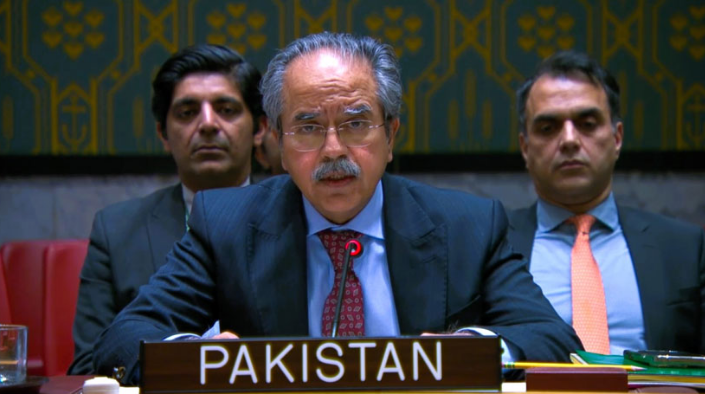
New York (Web Desk): A senior Pakistani diplomat expressed deep concern at the United Nations Security Council (UNSC) on Thursday over what he described as the calculated “weaponization of shared natural resources.” He specifically cited India’s unilateral decision earlier this year to suspend the 1960 Indus Waters Treaty, urging New Delhi to promptly return to full adherence with the landmark accord.
Ambassador Asim Iftikhar, Pakistan’s Permanent Representative to the UN, told the 15-member Council that such actions extend beyond bilateral harm, warning that they undermine international water law and encourage coercive practices based on control over shared resources.
India halted the World Bank–brokered treaty that governs water distribution from six rivers of the Indus Basin following the Pahalgam incident in April — a move that Pakistan considers both unlawful and destabilizing.
In his remarks during a broad debate on climate and security, the Pakistani envoy called the suspension a “textbook example” of turning common natural resources into tools of pressure. He reminded the Council that for more than six decades, the Indus Waters Treaty had functioned as a model of cooperation between the two neighbors, ensuring equitable and predictable allocation of river waters even during wartime.
Ambassador Iftikhar said India’s unilateral move violated both the spirit and the letter of the accord, endangering fragile ecosystems, halting vital data exchanges, and jeopardizing the livelihoods of millions who rely on the Indus system for food, energy, and survival. Such developments, he stressed, should concern not only Pakistan but the entire international community.
He pointed out that the treaty contains no clause permitting one-sided suspension or amendment and recalled that the Court of Arbitration’s 2025 award reaffirmed the treaty’s validity and the legitimacy of its dispute-resolution procedures. Pakistan, he said, therefore expects the treaty to be fully respected and normal mechanisms restored without delay.
The Council’s deliberations coincided with the International Day for Preventing the Exploitation of the Environment in War and Armed Conflict. Linking environmental degradation with insecurity, the Pakistani representative urged greater attention to conflict prevention and early resolution.
He suggested that environmental concerns be built into the planning, budgeting, and mandate design of UN peacekeeping and political missions, citing Pakistan’s long-standing role in peace operations.
Ambassador Iftikhar also underscored the importance of international humanitarian law, emphasizing that warring parties must differentiate between civilian and military targets and avoid methods of warfare likely to inflict long-lasting damage on the environment.
He called for stronger coordination across the UN system, including its country teams and regional bodies, to tackle the environmental and climate dimensions of conflict.
The envoy further emphasized the need for climate and biodiversity financing that is fresh, predictable, and grant-based—avoiding loans or overlapping allocations that count toward other development or humanitarian budgets.
Pakistan, he said, believes that effective action against climate change requires a cooperative approach rooted in the principle of common but differentiated responsibilities. Shared natural resources, he added, should become means of collaboration rather than instruments of division.
At the start of the session, Inger Andersen, Under-Secretary-General and Executive Director of the UN Environment Programme (UNEP), described how environmental destruction driven by conflict continues to push communities toward hunger, disease, and displacement.
She noted that since 2023, the Gaza Strip has lost nearly all its tree and shrub cover, while in Haiti, violence has aggravated contamination of soil and water in low-lying urban areas.
Andersen said that while the connection between climate and conflict is complex, climate change often intensifies instability.
A World Bank report in 2024 found that most conflict-affected areas are also facing longer and more severe droughts, while even excessive rainfall can spark violence by making fertile farmlands targets for competing groups.
She highlighted the stark inequality in global adaptation finance, observing that between 2014 and 2021, people in countries enduring severe conflict received only $2 per person in climate funding, compared to $162 in more peaceful states.
Inger Andersen urged greater international support to rebuild environmental management capacity in such regions, stressing that the UN system can serve as a trusted facilitator in these recovery efforts.
Neo News | Copyright © 2026