Thu, September 17, 2026

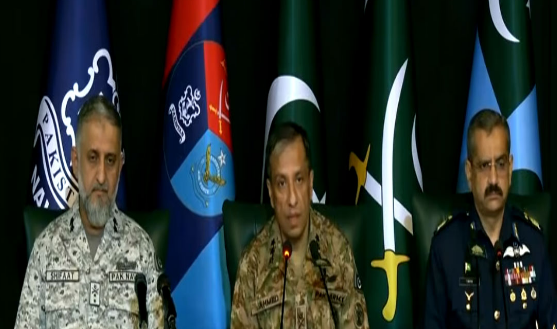
Rawalpindi (Web Desk): Director General (DG) Inter-Services Public Relations (ISPR) Lieutenant General Ahmed Sharif Chaudhry has said that, by the grace of Allah, Pakistan defeated an enemy many times larger that itself in the Marka-e-Haq.
Addressing a press conference alongside Deputy Chief of Naval Staff (Operations) Rear Admiral Shafaat Ali and Deputy Chief of Air Staff (Projects) Air Vice Marshal Tariq Ghazi on the completion of one year of Marka -e-Haq, he stated that the armed forces fulfilled the expectations of the nation with Allah’s mercy and blessings.
The DG ISPR said Pakistan defeated an enemy “five times larger” in a multi-domain war, adding that even Indian children know this reality, although it refuses to acknowledge it.
He added that this achievement reflected the strategic vision of both the country’s civilian leadership and military command.
The DG ISPR stated that the armed forces had fully lived up to the nation’s expectations during the course of Marka-e-Haq, adding that the military had delivered in line with public trust and national resolve.
Lt Gen Chaudhry described what he called ten key strategic outcomes of Marka-e-Haq, stating that the most significant among them was the collapse of India’s long-standing narrative linking Pakistan to terrorism.
The DG ISPR said the first and most significant outcome was the complete collapse of India’s longstanding narrative that labels Pakistan as a hub of terrorism.
Lt Gen Chaudhry said that the global community now clearly distinguishes Pakistan not as a source of terrorism but as a victim of state-backed terrorism allegedly originating from India.
The second outcome, he continued, was Pakistan’s reinforced standing as a stabilizing force in the region.
He emphasized that Pakistan is a peace-oriented country that strives for stability both within its borders and beyond them.
The DG ISPR also criticized India for escalating tensions based on what he termed false and fabricated claims, while praising Pakistan’s armed forces for handling the situation with restraint, maturity, and responsibility, thereby reinforcing Pakistan’s role as a key contributor to regional stability.
The third outcome he identified was the increasing politicization of India’s military leadership alongside the growing militarization of its political sphere.
The fourth development, he said, was the growing international recognition of India’s tendency to externalize its domestic challenges while internalizing external issues, including the alleged use of terrorism as a policy instrument.
Lt Gen Ahmad Sharif reiterated that Jammu and Kashmir is not an internal matter of India but a long-standing internationally recognized dispute, which remains on the agenda of the United Nations Security Council (UNSC) with multiple resolutions passed over several decades.
The fifth consequence, he noted, was the exposure of Indian media practices and its information campaigns at the global level, which he said had lost credibility.
The sixth outcome of Marka-e-Haq, he explained, was the evolving nature of warfare itself, now shaped by multi-domain operations, cyber dimensions, information warfare, proxy elements, and hybrid tactics.
The DG ISPR added that Pakistan remains fully prepared to respond across all domains including air, land, sea, cyber, and information.
The seventh outcome highlighted Pakistan’s resilience and its capability to counter both conventional and unconventional security threats.
The eighth, he said, was the clear reinforcement of deterrence, underscoring that there is no space for conflict between two nuclear-armed states.
The DG ISPR said that that the ninth outcome was Pakistan’s growing recognition on the global stage as a responsible and geopolitically important middle power.
The tenth and final outcome, which he described as the most crucial, was the strong and unbreakable unity between the people, the government, and the armed forces, a cohesion he referred to as the “Bunyan-um-Marsoos” effect.
Lt Gen Ahmad Sharif said that terrorist incidents inside Pakistan are being facilitated externally, claiming India’s involvement and stating that Afghanistan is being used as a base for such activities. He further pointed to an increase in militant incidents in Pakistan following Marka-e-Haq.
Reaffirming Pakistan’s defence stance, he said the armed forces, supported by the nation, would defend the country’s sovereignty and territorial integrity under all circumstances.
Responding to questions, the DG ISPR said that Operation Ghazab lil-Haq is still ongoing, though currently in a temporary pause phase.
He described it as part of Pakistan’s broader counter-terrorism strategy and stated that Islamabad’s clear demand to the Afghan Taliban authorities is to ensure that militant groups are not provided sanctuary on Afghan soil.
The military’s spokesperson further clarified that political dialogue is exclusively the domain of political parties, stressing that the armed forces do not engage in or represent political processes and do not align with any sectarian, linguistic, or ideological group.
During the briefing, the Deputy Chief of Naval Staff said that continuous surveillance by the Pakistan Navy had successfully prevented India from posing any threat to Pakistan’s maritime economic interests.
He added that during Marka-e-Haq, both the Pakistan Air Force and Navy were prepared to target the Indian aircraft carrier Vikrant, although it reportedly remained within a protected position and did not come out into open waters.
Meanwhile, Deputy Chief of Air Staff Pakistani forces had downed eight Indian aircraft, including four Rafale jets, one Su-30, one Mirage 2000, one MiG-29, and one high-value unmanned system, while several other aircraft were severely damaged beyond recovery.
He added that Pakistan also successfully struck 16 Indian airbases along with key operational facilities, BrahMos missile storage sites, critical command and control centres including one at Barnala, and two S-400 air defence batteries, according to the briefing.
On May 6-7, 2025, India carried out military action against Pakistan after levelling unsubstantiated accusations over an incident in Indian Illegally Occupied Jammu and Kashmir (IIOJK). Pakistan retaliated with full force, humiliating New Delhi.
The military confrontation lasted for more than 80 hours before ending on May 10 through mediation efforts led by the United States (US).
During the clashes, a number of Indian aircraft and drones were brought down, reinforcing Pakistan’s reputation as a “net security stabiliser” in the region.
Neo News | Copyright © 2026