Thu, September 17, 2026

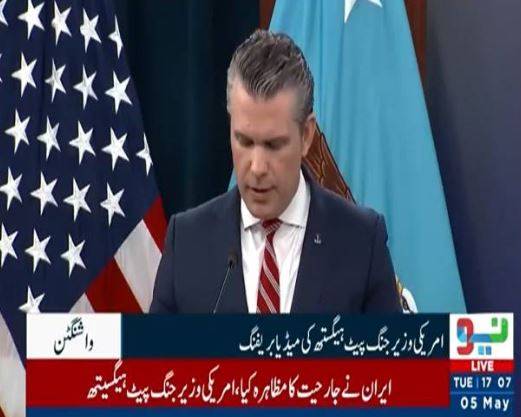
Washington (Web Desk): Following renewed flare-ups in the Strait of Hormuz, US Defense Secretary Pete Hegseth stated that the ceasefire between Washington and Tehran remains intact, insisting that recent tensions have not brought it to an end.
Speaking at a press briefing alongside US Joint Chiefs of Staff Chair General Dan Cainein Washington, he said, “No, the ceasefire is not over,” while downplaying the latest exchange of fire between naval forces in the region.
He further characterized the maritime incident, in which both sides reportedly targeted each other’s vessels, as “a separate and distinct project,” suggesting it is not directly linked to the broader ceasefire framework.
Hegseth explained that although confrontations have taken place at sea amid rising regional tensions, these developments are being treated as isolated incidents rather than a breakdown of the agreement.
He maintained that the ceasefire is still formally in place, with the current situation not amounting to a full resumption of hostilities between the two countries.
Hegseth said the United States is maintaining close surveillance of naval movements and maritime developments across the region. He explained that American naval forces are actively carrying out monitoring and security operations to ensure stability in international waters.
He said that US warships remain deployed in strategic areas and are continuing patrols aimed at safeguarding commercial shipping routes and protecting maritime traffic.
Hegseth noted that the US military considers the security of international waterways a major priority, particularly at a time of heightened regional tensions.
He said the presence of American naval assets is intended to support freedom of navigation and reassure allies and international shipping operators using key trade corridors.
The US defense secretary also highlighted the importance of the Strait of Hormuz, describing it as one of the world’s most critical maritime passages for energy supplies and global trade.
He pointed out that a significant portion of the world’s oil shipments passes through the narrow waterway, making its stability essential for the international economy.
He added that ensuring uninterrupted movement through the strait is not only a regional concern but also a collective responsibility shared by the global community.
Speaking further, Hegseth said the United States is continuing efforts to lower tensions in the Middle East while simultaneously strengthening maritime security measures.
He stated that Washington is in contact with regional allies and partners and is coordinating closely on matters related to naval security and the protection of commercial routes.
He stressed that the United States does not seek military confrontation with any country, including Iran, but made it clear that the safety and security of international sea lanes would remain non-negotiable.
He said any threat to commercial shipping or freedom of navigation would be taken seriously.
The defense secretary concluded by saying that the situation in the region is being monitored very carefully and that US authorities are prepared to respond according to future developments.
Neo News | Copyright © 2026