Thu, September 17, 2026

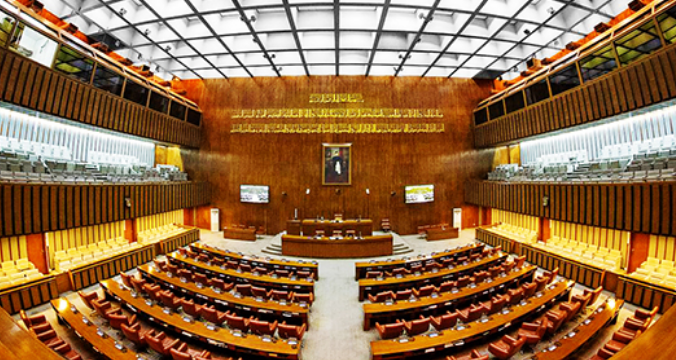
Islamabad (Web Desk): The Senate approved a private member’s bill proposing revisions to the National Accountability Ordinance (NAO) 1999, including the creation of a secondary appellate mechanism in accountability cases and clarifications on procedural matters concerning bail, jurisdiction, and the operational continuity of the National Accountability Bureau (NAB).
The National Accountability (Amendment) Bill, 2026, introduced by Senator Mohammad Abdul Qadir, allows parties dissatisfied with High Court decisions in NAB cases to file a second appeal with the Federal Constitutional Court (FCC) within 30 days, thereby expanding the scope of legal recourse in accountability matters.
Federal Law Minister Azam Nazeer Tarar told lawmakers that the government had no objections to the proposed changes, describing them as practical improvements to the existing legal framework. He noted that the amendments would resolve certain procedural uncertainties, particularly those related to bail authority and the handling of ongoing proceedings.
“These proposals are constructive,” Tarar said, emphasizing that the changes aim to provide clarity and reinforce legal protections in accountability cases.
Under the new provisions, accountability courts and relevant High Courts would have explicit authority to grant bail or order the release of accused individuals according to the applicable provisions of the Code of Criminal Procedure.
The bill also recommends that the NAB chairman be allowed to serve a three-year term, extendable once for an additional three years, replacing the current restriction that bars reappointment or extension.
Another proposed change would adjust the financial thresholds for NAB cases each year in line with inflation as reported by the Pakistan Bureau of Statistics, ensuring that monetary limits remain relevant over time.
Additionally, the bill clarifies that procedural rules governing accountability trials will also apply to appellate proceedings, eliminating interpretational ambiguities in the ordinance.
Leader of the House Senator Ishaq Dar expressed support for the legislation, calling it a constructive legal measure that should not be politicized.
He pointed out that the Constitution permits the Federal Constitutional Court to hear appeals from High Court decisions when parliament enacts legislation establishing such a forum.
“The Constitution explicitly allows the Federal Constitutional Court to hear appeals from High Court judgments and orders where an Act of Parliament provides for it,” Dar said.
He added that private member bills are a routine feature of parliamentary work and that additional amendments could be introduced in the future if required.
Treasury members argued that the bill would strengthen due process in accountability proceedings.
Law Minister Tarar noted that under current law, only one appeal, to the High Court, is available as of right, and that the amendments would provide litigants with an additional forum to challenge decisions.
He also said that the measure could address longstanding criticism that NAB’s legal framework is too strict and lacks sufficient safeguards for fundamental rights.
The bill was passed by voice vote despite some opposition. Following its approval in the Senate, it will now be forwarded to the National Assembly for consideration.
Neo News | Copyright © 2026