Thu, September 17, 2026

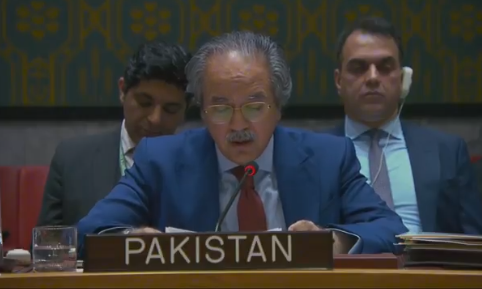
New York (Web Desk): Pakistan has called on the United Nations Security Council (UNSC) to take immediate action against the Baloch Liberation Army (BLA) following a series of devastating attacks in Balochistan that claimed numerous civilian and security lives.
Speaking at a UNSC briefing on threats to international peace posed by terrorism, Pakistan’s Permanent Representative, Ambassador Asim Iftikhar, urged the Council to designate the BLA under the 1267 sanctions framework, which already targets groups like Al-Qaeda and Daesh. Such a designation would require UN member states to freeze the group’s assets, impose travel restrictions, and enforce arms embargoes on individuals linked to the organisation.
The request comes after militants launched coordinated assaults across Quetta, Mastung, Nushki, Dalbandin, Kharan, Panjgur, Tump, Gwadar, and Pasni on January 31, killing at least 22 security personnel and 36 civilians.
In response, Pakistan’s security forces conducted an extensive counterterrorism operation, reportedly eliminating 197 militants. Balochistan Chief Minister Sarfraz Bugti said nearly 200 attackers were involved, many of whom deliberately used civilians as human shields, and most have either been killed or driven out of the province.
The attacks drew global condemnation, with countries including the United States, United Kingdom, Saudi Arabia, Qatar, Turkey, Iran, UAE, France, Canada, and the European Union denouncing the violence. The UNSC described the acts as “heinous and cowardly” and urged all nations to cooperate with Pakistan in holding the perpetrators accountable in line with international law.
Ambassador Iftikhar stressed Pakistan’s sacrifices as a frontline state in combating terrorism, noting that the country has endured over 90,000 casualties and immense economic losses in the fight against extremist groups.
He highlighted Pakistan’s success in countering Daesh-Khorasan while warning that groups like Fitna al-Khawarij, the Tehreek-e-Taliban Pakistan (TTP), and Fitna al-Hindustan BLA, along with its Majeed Brigade, have revived following the Taliban’s return to power in Afghanistan.
“These groups operate with near-total freedom from Afghan soil, supported by external actors, and are responsible for deadly attacks inside Pakistan,” he said, reaffirming Islamabad’s commitment to eliminating such threats and exposing the sponsors and financiers behind them.
The Pakistani envoy also warned that Al-Qaeda continues to benefit from Afghan de facto authorities’ patronage and that Daesh-K remains active, posing a wider regional threat.
He cited recent terrorist activity in Central Asia near Afghanistan as proof that unsecured weapons left behind in the country risk falling into militant hands.
The envoy called for a modernization of the UN’s counterterrorism framework to address contemporary threats effectively, emphasizing the need to tackle emerging forms of terrorism, including far-right extremism, white supremacist violence, violent nationalism, and Islamophobic attacks.
“Terrorism can only be defeated through global cooperation, without bias or double standards,” he said.
Ambassador Iftikhar also condemned state-sponsored repression, pointing to India’s actions in illegally occupied Jammu and Kashmir, and stressed that occupation and violent suppression cannot be disguised as counterterrorism.
He reiterated that peoples’ legitimate struggles for self-determination, recognized under UN resolutions, must be respected and protected.
Neo News | Copyright © 2026