Thu, September 17, 2026

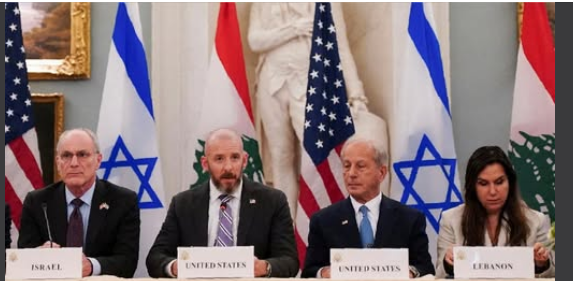
Washington (Web Desk): Israel and Lebanon announced on Wednesday that they had agreed to move forward with a ceasefire arrangement following US-sponsored negotiations in Washington, although both parties made it clear that the deal depends on Hezbollah ending its military operations entirely.
In a joint declaration issued after the talks, the two sides revealed plans to establish “pilot zones” where the Lebanese military would assume sole responsibility for security and administration. Under the proposal, the armed forces “will take exclusive control of the territory to the exclusion of all non-state actors”.
The breakthrough emerged despite fresh exchanges of fire earlier in the day. Hezbollah said it had launched attacks against Israeli forces, while Israeli strikes in southern Lebanon reportedly left at least ten people dead.
Only hours after the announcement, warning sirens were activated across northern Israel after authorities detected a “suspicious aerial target”, though no injuries or damage were reported.
The statement further stressed that the ceasefire remained “contingent on a complete cessation” of Hezbollah attacks, alongside the withdrawal of the group's members from southern Lebanon.
The Washington meetings represented the fourth round of direct discussions between Lebanese and Israeli officials since hostilities intensified on March 2, when Hezbollah resumed attacks against Israel in support of Iran.
According to the statement, both delegations are scheduled to reconvene during the week of June 22 “with a view toward reaching a comprehensive agreement”.
Earlier on Wednesday, US President Donald Trump said he preferred to keep negotiations concerning Lebanon separate from those related to the conflict involving Iran.
Iran, however, rejected that distinction. Tehran continues to argue that the regional confrontations are interconnected, while Foreign Minister Abbas Araghchi warned that any strike on Beirut would result in a “full-scale resumption” of war.
The Israeli military stated that it had shot down a “hostile aircraft” and intercepted two projectiles launched from Lebanese territory on Wednesday.
Hezbollah, meanwhile, said that “in response to the Israeli enemy army’s violation of the ceasefire”, its fighters launched a barrage of rockets at Israeli troops stationed in northern Israel.
In a statement released early Thursday, the group said it fired a “salvo of rockets” at Israeli soldiers and military vehicles in the southern Lebanese town of Al-Qantara. It also claimed responsibility for sending two drones toward an Israeli command site near Chqif Castle.
A ceasefire that was supposed to end the fighting on April 17 has effectively failed to take hold, with each side accusing the other of repeatedly breaching the agreement.
On Tuesday, senior Hezbollah figure Mahmud Qomati reiterated that the movement would “not accept a partial ceasefire”.
Among Wednesday’s attacks was an Israeli strike on a vehicle travelling along the main highway leading out of Beirut, according to Lebanon’s state-run National News Agency (NNA).
The agency also reported Israeli bombardments targeting more than 20 sites across southern Lebanon, some occurring after the Israeli military instructed residents of several villages to evacuate.
Lebanon’s Health Ministry said an Israeli strike on Al-Hawsh, near the city of Tyre, killed four Syrian nationals and two Palestinians.
The ministry also reported that another Israeli attack struck an ambulance in southern Lebanon, killing two paramedics affiliated with the Risala Scouts Association.
Photographs released by officials showed the ambulance severely damaged, with medical masks and equipment scattered across the road.
Later, authorities confirmed the death of a third paramedic in an attack that the NNA said targeted an ambulance crew linked to the Islamic Health Committee in the town of Zibdine.
Since the conflict began, at least 130 emergency responders and healthcare workers have reportedly lost their lives.
The Lebanese Army also announced that one of its soldiers was killed in an Israeli strike, while an officer and another soldier sustained injuries in a separate attack involving a military vehicle.
The army condemned what it described as Israel’s “deliberate targeting of army personnel, vehicles and positions”.
Neo News | Copyright © 2026