Thu, September 17, 2026

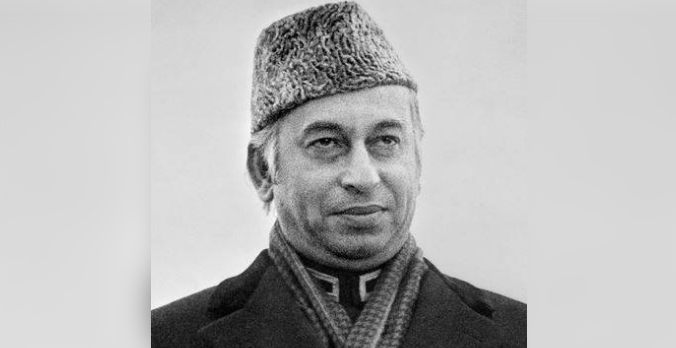
Larkana (Web Desk): The 47th death anniversary of former Prime Minister and founder of Pakistan Peoples Party (PPP), Shaheed Zulfikar Ali Bhutto is being observed today (Saturday).
To commemorate the occasion, the Government of Sindh has declared a public holiday, enabling people to take part in remembrance activities.
Observances are being held across the country in a modest and restrained manner, in keeping with the government’s ongoing austerity policy, while still acknowledging Bhutto’s lasting political legacy.
Supporters and workers of the PPP are also honoring the memory of Shaheed Benazir Bhutto along with other senior party figures, paying tribute to their services and sacrifices for democracy.
Political leaders across the country are honoring the enduring legacy of Zulfikar Ali Bhutto, acknowledging his pivotal role in shaping Pakistan’s constitutional framework and strengthening its democratic foundations.
PPP Chairman Bilawal Bhutto Zardari, while paying the glowing tribute to party’s founder, called him a visionary leader whose sacrifice continues to echo as a powerful symbol of democracy and the people’s honour.
In his message, he said that the country’s first elected prime minister of Pakistan, Shaheed Zulfikar Ali Bhutto, was the architect of a Pakistan where power rests with the people and where the sun of hope rises each day from the hearts of the deprived.
He stressed that the martyrdom of Quaid-e-Awam was not the silencing of a voice, but the awakening of a nation’s conscience.
Bilawal described Bhutto as a towering and multidimensional figure in history who redirected Pakistan’s political and social direction.
He said Bhutto Shaheed gifted the nation the unanimously adopted Constitution of 1973, empowered the people with the strength of their vote, established institutions reflecting the will of the masses, introduced historic agrarian and industrial reforms to uplift workers and farmers, laid the foundation of the nuclear program to make national sovereignty inviolable, and strengthened Pakistan’s position on the global stage. This, he said, is a legacy that continues to guide Pakistan’s democratic journey.
On the occasion, he also paid tribute to Benazir Bhutto, the first woman Prime Minister of the Muslim world, saying that she carried forward Quaid-e-Awam’s legacy with unmatched courage and dignity, emerging as a symbol of resistance against dictatorship.
Bilawal added that her life was not only a continuation of Bhutto Shaheed’s mission, but also a powerful reaffirmation that the struggle for democracy, justice, and equality must endure across generations.
Reflecting on April 4, he said every patriotic Pakistani remembers Quaid-e-Awam with deep respect and renews the commitment to building the kind of Pakistan he envisioned — a strong, democratic, and welfare-oriented state. “His dream remains a sacred trust with us,” he added.
President Asif Ali Zardari, in his message marking the death anniversary of Zulfikar Ali Bhutto, urged the nation to learn meaningful lessons from the past, stressing that state institutions must remain committed to the rule of law, uphold due process, and ensure justice is delivered without bias.
“Today, we observe the 47th anniversary of the martyrdom of Shaheed Zulfikar Ali Bhutto, former Prime Minister and founder of the Pakistan Peoples Party, whose life was brought to an end unfairly on 4 April 1979 following a trial conducted under the martial law regime of General Zia-ul-Haq,” the president said, noting that Bhutto continues to hold a defining place in the country’s political narrative.
He observed that Bhutto’s leadership in the difficult period following 1971 helped rebuild public confidence and set Pakistan on a renewed constitutional trajectory.
Reflecting on his contributions, the president stated, “The adoption of the Constitution of 1973, which continues to guide our parliamentary system, remains one of the most enduring achievements of that period,” adding, “His government also laid the foundations for policies and institutions that shaped Pakistan’s strategic direction and national outlook in the years that followed.”
Referring to recent legal developments, the president highlighted that nearly fifty years after Bhutto’s execution, the Supreme Court of Pakistan, in its opinion issued on 6 March 2024, determined that he had been denied a fair trial and proper due process.
The court observed that the proceedings “destroyed any semblance of due process and fair trial, and revealed that innocent” man was “rushed to the gallows.”
He said the court pointed out multiple serious irregularities in the case. According to him, the investigation into the murder had originally been closed in May 1976 after authorities failed to trace those responsible, but it was reopened without lawful justification soon after 5 July 1977, following the coup led by Zia-ul-Haq that removed Bhutto from power.
The president further explained that the case was shifted to the Lahore High Court in an unusual manner without informing the accused, effectively denying him a right to appeal and bypassing critical legal safeguards. This included ignoring the requirement under Section 376 of the Code of Criminal Procedure, which mandates High Court confirmation of death sentences—a provision the court noted “has only once been disregarded, which was in this case.”
He added that Bhutto’s execution in 1979 also drew concern from the international community, with several global leaders and observers expressing reservations about the circumstances surrounding the trial and verdict.
President Zardari said that this episode remains significant not only within Pakistan’s political history but also in broader discussions about justice, governance, and authority.
He remarked that the day serves as a reminder that justice and due process are not merely theoretical concepts but principles that directly affect citizens in their everyday interactions with institutions. When laws are applied fairly, people develop confidence that their rights will be protected, but when such standards weaken, it is ordinary citizens who feel the impact most strongly.
President Zardari also paid tribute to Benazir Bhutto, acknowledging her courage and perseverance, and noting that with the support of her mother, Nusrat Bhutto, she carried forward the struggle during a time marked by repression, imprisonment, and exile.
Through sustained democratic efforts, including movements such as the Movement for the Restoration of Democracy, she continued the fight to restore constitutional order and ultimately sacrificed her life for democratic values.
“As a nation, we must draw clear lessons from this chapter of our history. Our institutions carry a lasting responsibility to uphold the rule of law, protect due process and ensure that justice is administered fairly and without prejudice,” he said, adding that adherence to these principles is essential for strengthening democracy and preserving public trust in state institutions.
Prime Minister Shehbaz Sharif also remembered former prime minister Zulfikar Ali Bhutto on his death anniversary, paying homage to his lasting impact on Pakistan’s national, political and constitutional journey.
According to a statement released by the Prime Minister’s Office Media Wing, the premier spoke of Bhutto’s dedicated leadership, noting that his time in office was marked by determined efforts to steer the country toward progress, economic growth and a stronger defence framework.
He drew particular attention to Bhutto’s leading role in shaping and securing the passage of the 1973 Constitution, describing it as a defining document that laid the groundwork for parliamentary democracy and strengthened democratic traditions in the country.
The prime minister also highlighted Bhutto’s unwavering faith in democratic principles, pointing out that his governance approach remained focused on addressing the concerns of ordinary citizens and prioritising public welfare.
He further observed that during his tenure, Bhutto actively represented Pakistan at the international level, ensuring the country’s voice was heard in global affairs.
PM Shehbaz offered prayers for the departed leader, expressing hope for his elevated status in the hereafter and affirming that his contributions to the nation would continue to be remembered with respect.
Neo News | Copyright © 2026