Thu, September 17, 2026

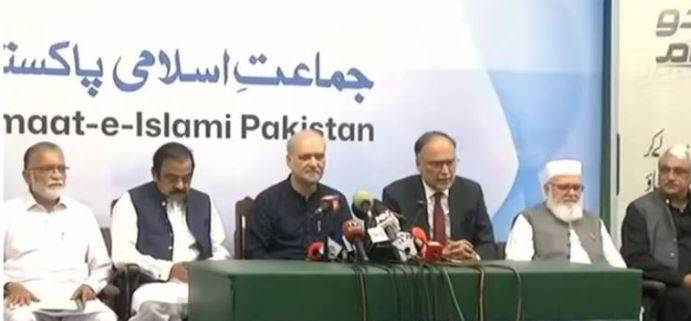
Lahore (Web Desk): The federal government and Jamaat-e-Islami (JI) have agreed to set up separate committees to explore practical steps for easing the financial pressure on citizens as inflation and petroleum prices continue to rise.
Federal Minister for Planning Ahsan Iqbal announced the decision during a joint press conference alongside JI Emir Hafiz Naeemur Rehman and Prime Minister’s Adviser on Political Affairs Rana Sanaullah. He said the government had already established a committee and had asked JI to nominate its own group of experts for the discussions.
The agreement came as JI continued its countrywide campaign against the petroleum levy, soaring inflation and expensive electricity. The strike, however, saw varying levels of participation across the country. Several markets and shops remained partly shut in areas of Sindh and Khyber Pakhtunkhwa, while commercial activity largely continued in Punjab and Balochistan.
Earlier, a government delegation comprising Ahsan Iqbal, Rana Sanaullah and Punjab Minister Khawaja Salman Rafique visited JI’s headquarters at Mansoorah in Lahore for negotiations with the party leadership.
JI’s side was headed by Deputy Emir Liaquat Baloch and included Deputy Secretary Farasat Shah, Islamabad Emir Nasrullah Randhawa, Lahore Emir Ziauddin Ansari and Naveed Ali Baig.
During the talks, JI placed its key demands before the government. These included scrapping the petroleum levy, ending agreements with independent power producers and bringing down electricity tariffs.
The government representatives acknowledged that the demands were reasonable but pointed out that petroleum prices also had to be assessed in light of fluctuations in the international market.
At the press conference, Iqbal said the negotiations were taking place on the instructions of Prime Minister Shehbaz Sharif.
“Both the government and Jamaat-e-Islami want relief for the people,” he said, adding that the government would consider JI’s suggestions concerning the petroleum levy and adopt every feasible measure to lessen the financial pressure on consumers.
Iqbal said the government had already assembled a panel of experts and suggested that JI form a similar team. He explained that the two sides would work together through these committees to develop a workable plan for providing relief to the public.
He added that the government would study JI’s recommendations and pursue their implementation wherever possible in an effort to lower the financial burden on ordinary citizens.
The planning minister also pointed to the reduction in the policy interest rate, saying it had come down from 23.5% to 11.5%. He criticised the economic conditions inherited by the present administration, describing the previous four years as a “dark period”.
Iqbal further said Pakistan had not entered the International Monetary Fund programme willingly, but was currently dealing with the country’s economic difficulties within the existing circumstances.
He announced that formal negotiations between the government and JI would officially begin on Monday.
Rana Sanaullah said both sides were on the same page when it came to the need to provide relief to the people.
According to him, JI had presented proposals that it believed could reduce the pressure on consumers, and the government was willing to assess those suggestions.
Sanaullah said officials from the Federal Board of Revenue, Ministry of Finance and Ministry of Petroleum would coordinate their efforts to identify possible measures for reducing the public’s financial burden.
He said higher international prices had contributed to the increase in domestic costs and noted that the war involving Iran had further intensified the pressure on ordinary citizens.
Sanaullah also acknowledged JI’s campaign, saying the party’s efforts had played a role in bringing improvements to the electricity sector.
Hafiz Naeem described the talks as constructive and thanked the government delegation for visiting the JI headquarters in Mansoorah.
He said JI’s sit-ins had now reached their 19th consecutive day, with the campaign expanding from the original three sites to 15 locations.
The JI emir reiterated that the demonstrations were not being organised for personal political gains or electoral objectives, but were aimed at obtaining economic relief for the people.
He said rising inflation had made everyday life increasingly difficult. Hafiz claimed that over 40% of the population was living below the poverty line, while around 95% of people were struggling to fulfil their basic requirements.
He also claimed that poverty had risen by 33% during the last six years.
Hafiz Naeem strongly objected to the petroleum levy, claiming that the government had generated more than Rs8 trillion through it.
He argued that even citizens who do not directly pay income tax are effectively contributing a significant amount through levies imposed on petroleum products. He particularly described the financial impact on motorcycle riders and other low-income consumers as unfair.
The JI leader also raised concerns over capacity payments made to independent power producers, including charges for electricity that was never actually produced. He also criticised capacity-related payments associated with regasification plants.
Hafiz said JI had identified several areas where government spending could be curtailed, arguing that reducing unnecessary expenditure could help bring inflation down.
The party is demanding lower prices for petrol, cheaper flour and reduced electricity tariffs.
Hafiz Naeem said the government had asked JI to consider delaying its sit-ins, but the party had made it clear that the demonstrations would remain in place during the negotiation process.
“Negotiations will be more meaningful if the sit-ins continue,” he said.
He added that JI would submit comprehensive proposals to the government, focusing on measures that could reduce living costs and deliver immediate financial relief to the public.
Neo News | Copyright © 2026