Wed, September 16, 2026

Islamabad (Web Desk): The federal government has announced a massive increase in the prices of petrol and diesel in view of rising energy costs in the international market due to the Middle East conflict.
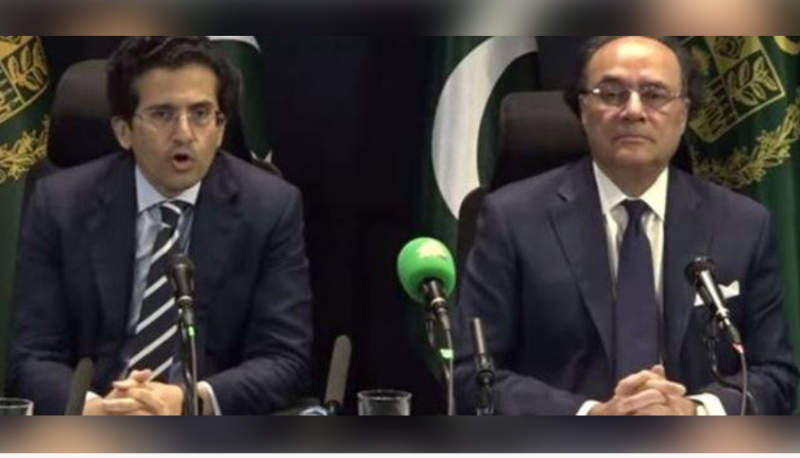
Federal Minister for Petroleum Ali Pervaiz Malik and the Finance Minister made the announcement during a joint press conference on Thursday.
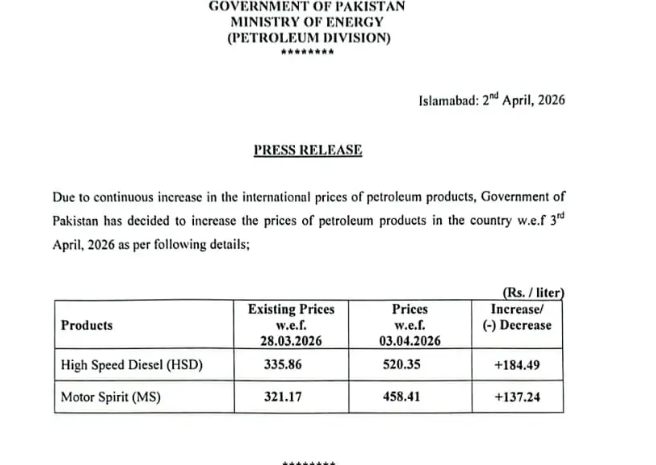
According to the announcement, the price of petrol has been increased by Rs137.24 per litre, bringing the new price to Rs458.41 per litre.
Similarly, the price of diesel has been raised by Rs184.49 per litre, after which the new price of diesel has been set at Rs520.35 per litre.
The government has also issued an official notification regarding the increase in petroleum prices.
The new prices come into effect from 12:00am, April 3, 2026 (Friday).
Sources said that the petroleum levy on petrol has been increased by Rs55.24 per litre, taking the total levy on petrol to Rs160.61 per litre.
On the other hand, the levy on diesel has been reduced to zero, whereas previously a levy of Rs55.24 per litre was being charged on diesel.
Addressing the press conference, Ali Pervaiz Malik stated that global oil prices have surged sharply because of the ongoing conflict in the Middle East.
He added that the war has spread beyond the region and is now affecting the entire world.
The minister said the government will now shift its focus towards targeted subsidies rather than blanket subsidies to better protect the most vulnerable segments of the society.
Malik pointed out that the persistent rise in international oil prices has made it necessary to revise domestic fuel rates.
The petroleum minister further said that through various austerity steps, the federal government has managed to save Rs129 billion.
He added that these funds are intended to serve as a buffer to lessen the burden of rising global prices on ordinary citizens.
Addressing the joint presser, Finance Minister Muhammad Aurangzeb announced that a “Targeted Subsidy Program” will be introduced to assist low- and middle-income groups.
He said that resources are being redirected toward those who are most deserving and in need.
Under this plan, motorcyclists and other two-wheeler users will receive a subsidy of Rs100 per liter, with a monthly limit of 20 liters. This support will continue for 3 months.
Small-scale farmers will be provided with a one-time subsidy of Rs1500 per acre to help cover harvesting costs.
For inter-city public transport and freight services, a subsidy of Rs100 per liter will be granted for a period of 1 month.
Muhammad Aurangzeb added that truck operators will receive Rs70,000 per month, while heavy-duty vehicle owners will be given Rs80,000.
Passenger and public service buses will be allotted a subsidy of Rs100,000. He also noted that these measures will be reviewed again next month.
Muhammad Aurangzeb further said that financial support will be extended to Pakistan Railways to help lower fares for lower-income passengers.
The finance minister also mentioned that the government is considering revised market timings, which are expected to be implemented next week after consultations with provincial governments.
It is pertinent to mention that the global oil and energy markets were thrown into turmoil after the United States (US) and Israel carried out coordinated strikes against Iran on February 28.
In retaliation, Tehran effectively shut down the Strait of Hormuz—a crucial maritime corridor—and launched attacks on oil refineries across the Gulf.
The instability across the Gulf region triggered a surge in international oil and energy prices, prompting nations worldwide to implement fuel rationing and conservation measures.
Pakistan also introduced an extensive austerity and energy-saving strategy, initially announcing a steep increase of Rs55 per litre in petrol and diesel prices on March 6.
However, in the three subsequent weekly reviews, the federal government chose to keep petroleum prices unchanged.
Neo News | Copyright © 2026