Thu, September 17, 2026

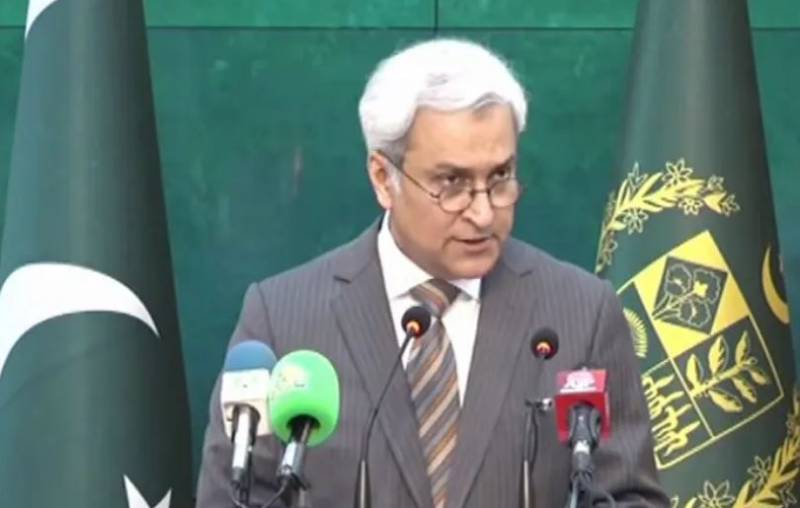
Islamabad (Web Desk): Pakistan on Wednesday welcomed the Permanent Court of Arbitration’s (PCA) ruling on the Indus Waters Treaty (IWT), describing its findings as “clear and authoritative pronouncements.”
Speaking at his weekly media briefing, Foreign Office (FO), Spokesperson Tahir Andrabi said that the decision reaffirmed Islamabad's right to pursue every available diplomatic and legal option to safeguard its water rights and called on New Delhi to fully honour its treaty commitments.
He said that unanimous award delivered by the arbitration court was a significant confirmation of both the importance of the Indus Waters Treaty and the authority of international law.
He said the verdict had strengthened Pakistan’s longstanding stance that disputes or differences over the Indus water system should be resolved only through the procedures laid down in the treaty and in accordance with international legal principles.
Andrabi pointed out that the case before the Permanent Court of Arbitration had itself been handled under the dispute-resolution provisions established by the Indus Waters Treaty.
“India’s rejection of the award by the Permanent Court of Arbitration raises concerns that extend well beyond the present dispute. India cannot treat international law as a matter of convenience—invoking it when useful and discarding it when inconvenient,” he said.
The spokesperson argued that India could not simply set aside obligations arising from a binding international agreement or reject the legal mechanisms created to settle disputes.
He cautioned that such conduct could weaken respect for treaties, reduce confidence in established international arbitration systems and establish an undesirable example for other disputes around the world.
“India should, therefore, return to full compliance with the treaty, respect the institutional and dispute settlement mechanisms of the treaty, and engage Pakistan constructively within the framework that both countries solemnly accepted.”
Andrabi further said that the position expressed by India’s Ministry of External Affairs could not cancel, modify or otherwise affect the obligations India has under the Indus Waters Treaty, including its responsibility to implement the Court of Arbitration’s award.
“Pakistan is committed to implementing it in earnest, in letter and in spirit, in accordance with the language and provisions of the treaty. We will continue to urge India to reciprocate with the same approach whereby the treaty is upheld in letter, in spirit, and in full legal and documented provisions.”
Moving to Afghanistan-related matters, Andrabi said Pakistan welcomed the visit of China’s Special Envoy for Afghanistan and valued Beijing’s continued efforts to remain engaged with issues surrounding the neighbouring country.
He said Islamabad had consistently supported meaningful and constructive dialogue on Afghanistan.
However, he stressed that tangible progress would require the interim Taliban authorities to take concrete, verifiable measures against the TTP, BLA and other militant groups allegedly using Afghan territory to carry out attacks against Pakistan.
When asked about the continuing hostilities between the United States and Iran and the status of the Islamabad MoU, the spokesperson said Pakistan was carefully following the evolving situation.
“We are closely monitoring the situation… International armed conflicts have their cycles, whereby a period of escalation is followed by relative calm, eventual cessation of hostilities, and an ultimate return to the negotiation table.
This is the standard pattern of international armed conflicts. While we remain concerned and these escalations are certainly not desirable, we are not discouraged and we remain engaged.”
Andrabi rejected the idea that the latest escalation should automatically be viewed as a breakdown of mediation efforts, saying Pakistan continued to participate in the peace process with full seriousness.
He recalled that after Prime Minister Shehbaz Sharif’s meeting with the Iranian president, the premier had described the Islamabad MoU as a framework that could enable the sides to resume negotiations.
This, he said, could include technical-level discussions aimed at finding a durable and sustainable solution to the ongoing standoff.
Regarding the criminal proceedings involving Kashmir leader Yasin Malik, Andrabi made it clear that Pakistan’s position on Jammu and Kashmir had not changed.
“Pakistan’s position on Jammu and Kashmir is firmly anchored in UN Security Council resolutions, international law, and the wishes of the Kashmiri people…We remain fully engaged with this issue at relevant international platforms.”
He said that PM Shehbaz and Deputy Prime Minister and Foreign Minister Ishaq Dar had also met with the UN secretary-general during their engagements in Bishkek. Andrabi added that Jammu and Kashmir continued to remain among Pakistan’s key priorities at the United Nations.
Commenting on the European Commission’s newly issued bi-annual GSP Monitoring Report, he said Pakistan welcomed the document and appreciated the Commission’s acknowledgement of the country’s continued adherence to the relevant international conventions.
At the same time, he maintained that the report’s overall assessment did not provide a sufficiently balanced account of Pakistan’s performance.
Responding to a question about terrorism, Andrabi said Pakistan’s counter-terrorism strategy had both domestic and external aspects. On the domestic front, he said the country’s security forces were continuing major operations against militant threats.
The external challenge, he explained, included alleged assistance from elements based in Afghanistan, including the interim Taliban authorities, to terrorist groups carrying out activities inside Pakistan.
He also accused extra-regional forces, particularly India, of providing support and facilitation to such groups, saying Pakistan had concrete evidence concerning these allegations.
Turning to Pakistan’s diplomatic activity over the past week, Andrabi said the country had maintained an active foreign-policy schedule, involving high-level bilateral, regional and multilateral contacts designed to advance national priorities and strengthen relations with important partner countries.
He highlighted PM Shehbaz Sharif’s official visit to Kyrgyzstan for the Shanghai Cooperation Organisation (SCO) Summit.
During the visit, the prime minister delivered significant statements and participated in a number of bilateral meetings on the sidelines, while Deputy Prime Minister Ishaq Dar also met several foreign leaders.
Andrabi said Pakistan had taken over the chairmanship of the Shanghai Cooperation Organisation and would host the next SCO Council of Heads of State summit in 2027.
The FO spokesperson also spoke about the inaugural session of the Strategic Political and Defence Committee established through the Makkah Joint Defence Agreement between Pakistan, Saudi Arabia and Türkiye.
The meeting in Istanbul saw the three countries renew their commitment to regional stability, peace and de-escalation, including by promoting restraint and resolving crises through peaceful means.
He said the agreement also envisaged the creation of a Secretariat in Saudi Arabia, to be headed by a Secretary-General. Pakistan will provide the first Secretary-General, who will serve for an initial three-year period.
The briefing was Andrabi’s last in his capacity as Foreign Office spokesperson before he assumes his new diplomatic assignment as Pakistan’s Permanent Representative to Geneva. He formally transferred the spokesperson’s responsibilities to Ambassador Sajjad Haider Khan, who will now serve as the new Foreign Office spokesperson.
Neo News | Copyright © 2026