Thu, September 17, 2026

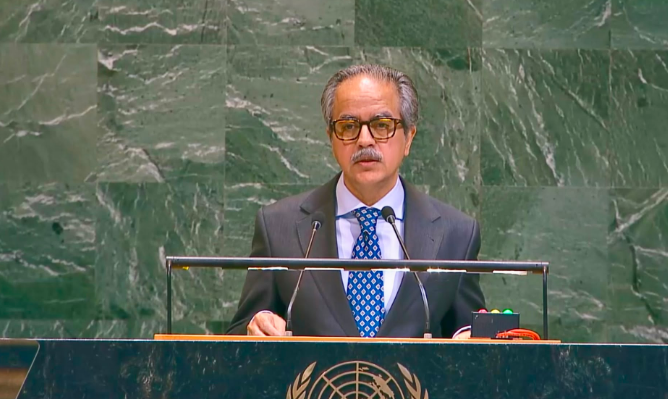
New York (Web Desk): Amid heightened tensions in the Middle East and ongoing diplomatic engagement concerning the United States (US)-Iran standoff, Pakistan has called on the international community to make mediation a central element of conflict prevention rather than relying on it only after disputes escalate into crises.
The message was delivered on Monday by Pakistan’s Permanent Representative to the United Nations, Ambassador Asim Iftikhar Ahmad, during the UN General Debate focused on enhancing mediation as a means of preventing conflicts and promoting their peaceful resolution.
Addressing delegates, the ambassador stated that resolving disputes through peaceful means remains a key pillar of Pakistan’s foreign policy and a fundamental commitment under the United Nations Charter.
He remarked that the real measure of dedication to peace lies not in reacting to wars and conflicts once they begin, but in taking effective steps to stop them from occurring in the first place.
Emphasising the value of mediation, he described it as a crucial pathway from hostility to harmony. According to him, mediation allows diplomacy to fulfil its purpose by encouraging reason over force, dialogue over silence, and justice over suffering.
He observed that many conflicts take root when diplomatic efforts are postponed, communication channels are neglected, and unresolved issues are allowed to deepen.
#PakistanAtUN
— Permanent Mission of Pakistan to the UN (@PakistanUN_NY) June 1, 2026
At UN, Pakistan Urges Early Diplomacy and Stronger UN Mediation Architecture for Lasting Peace
- Our Press Release today pic.twitter.com/CjVfyNZIyV
In this context, he stressed that the United Nations (UN) must focus not only on managing crises after they emerge but also on preventing them before they inflict lasting damage on societies and future generations.
Ambassador Ahmad also highlighted UN Security Council Resolution 2788, which Pakistan introduced and which received unanimous approval in July 2025.
He noted that the resolution reaffirmed the significance of Chapter VI of the UN Charter, promoted the wider use of mediation and good offices, and recognised the important role of both the United Nations and regional organisations in settling disputes peacefully.
The Pakistani envoy said these principles have consistently guided Pakistan’s diplomatic engagement, including its approach during the recent developments in the Middle East.
Referring to Pakistan’s relationships across the region and beyond, the envoy said that as a friendly neighbour of Iran, a close partner of Gulf nations, and a country that has maintained longstanding cordial ties with the US, Pakistan remains committed to supporting efforts aimed at achieving sustainable peace and stability at both regional and global levels.
Presenting Pakistan’s recommendations for strengthening mediation, he called for earlier intervention through stronger early-warning mechanisms, preventive diplomacy initiatives, the good offices of the UN Secretary-General, and more active utilisation of Chapter VI provisions.
He further underlined the need to ensure that mediation efforts remain firmly rooted in international law and the principles of the UN Charter.
The Pakistani envoy also advocated addressing the underlying causes of conflicts, enhancing the UN’s mediation framework through dependable funding and stronger cooperation with partners, and encouraging disputing parties to regard mediation as a responsibility owed to their citizens and to international peace.
Ambassador Ahmad reaffirmed Pakistan’s commitment to supporting mediation as a vital component of collective international efforts aimed at preventing conflicts, resolving disputes peacefully, and promoting lasting peace.
Neo News | Copyright © 2026