Thu, September 17, 2026

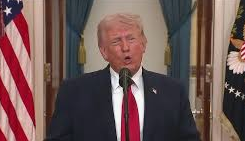
Washington (Web Desk/Agencies): US President Donald Trump defended his handling of the ongoing US-Israeli war on Iran, asserting that American forces were close to achieving their objectives while simultaneously warning of further devastating strikes with threats to send the Islamic Republic ‘back to the Stone Age’
Speaking for 19 minutes during a prime-time televised speech, Trump addressed the nation at a moment marked by soaring global oil prices and declining approval ratings at home.
He claimed that US operations had effectively dismantled Iran’s naval and air capabilities and significantly weakened its ballistic missile and nuclear infrastructure.
The US President added that American forces would continue to strike Iranian targets “extremely hard” over the coming weeks but avoided committing to a clear timeline for ending the conflict.
Despite expressing confidence that military goals could be met swiftly, Trump indicated the possibility of escalation, particularly if Iran refused to yield during negotiations.
He suggested that additional attacks on the country’s energy sector could be carried out, a move that risks further destabilising global markets and intensifying the crisis.
The president’s remarks appeared unlikely to reassure investors or the American public, both of whom remain uneasy about what has become Washington’s largest military engagement since the 2003 invasion of Iraq.
Throughout the conflict, Trump has delivered mixed messages—alternating between calls for diplomacy and threats of intensified military action—contributing to uncertainty over US intentions.
He also refrained from clarifying whether operations could conclude before Iran reopens the Strait of Hormuz, a critical artery for global energy supplies. Instead, Trump urged nations dependent on Gulf oil to take responsibility for securing the passage, emphasising that the United States is less reliant on the region’s energy resources.
However, key Western allies have shown reluctance to become directly involved in a war initiated by Washington and Israeli Prime Minister Benjamin Netanyahu without prior consultation. While Trump stopped short of repeating earlier suggestions that the US might reconsider its role in NATO, tensions with allies remain evident.
Analysts warn that without a decisive outcome, Iran could retain significant leverage over the Strait of Hormuz, through which roughly one-fifth of global oil and gas shipments pass.
Meanwhile, Gulf allies may be left vulnerable if the US withdraws prematurely, facing a weakened yet still hostile Iran.
Although Trump touted military successes, doubts persist over whether the central objective—blocking Iran’s path to a nuclear weapon—has been achieved. Iran is still believed to possess a stockpile of highly enriched uranium, much of it reportedly buried deep underground following earlier US-Israeli strikes.
In a notable shift, Trump signalled he was no longer concerned about securing the uranium, suggesting it was too deeply buried to retrieve and could instead be monitored via satellite. Iran, for its part, has consistently denied pursuing nuclear weapons despite longstanding accusations from Washington and Tel Aviv.
While warning of further airstrikes if Iran attempted to relocate the material, Trump made no mention of deploying ground forces, an option US officials have reportedly considered but one likely to face strong domestic opposition.
Despite claims that Iran’s conventional military capabilities have been severely degraded, Tehran has continued to demonstrate its ability to launch missile and drone attacks targeting Israel, US allies in the Gulf, and American military installations in the region.
Efforts to bring about regime change in Iran have also fallen short. Although US-Israeli strikes reportedly eliminated several senior leaders, including Supreme Leader Ali Khamenei, they have been replaced by more hardline figures, with US intelligence assessments indicating that the broader governing structure remains intact.
The speech—Trump’s first prime-time address since the conflict began on February 28—was expected to reassure a war-weary American public. Instead, it offered only brief acknowledgment of domestic economic concerns, particularly rising fuel costs, which Trump attributed to Iranian actions targeting commercial oil shipping.
While his political base has largely remained supportive, prolonged economic strain could erode that backing, especially as Republicans prepare for upcoming midterm elections. A recent Reuters/Ipsos poll placed Trump’s approval rating at 36%, his lowest since returning to office.
Financial markets reacted negatively following the address, with stocks falling, the dollar strengthening, and oil prices climbing—reflecting investor unease over the lack of a clear strategy for ending the conflict.
Though the speech provided Trump with a high-profile opportunity to reset the narrative, his subdued delivery and reliance on familiar talking points did little to clarify the broader rationale behind the war or outline a definitive path forward.
Neo News | Copyright © 2026