Thu, September 17, 2026

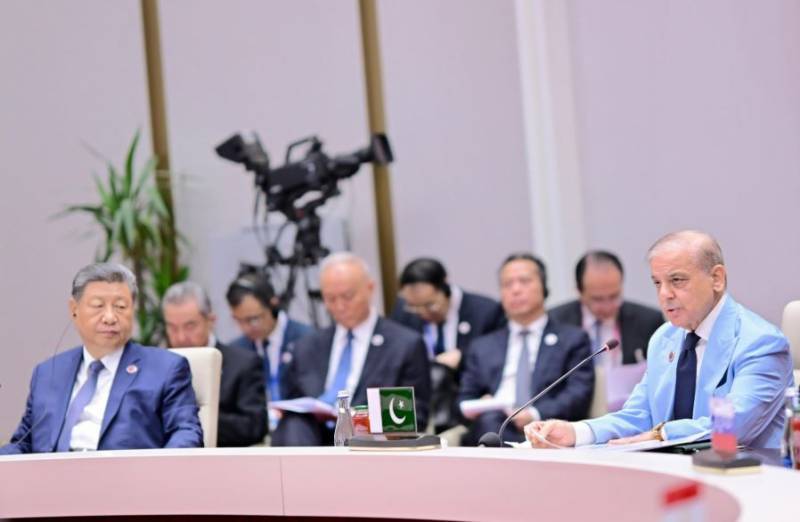
Islamabad (Web Desk): Prime Minister Shehbaz Sharif has reaffirmed that Pakistan remains committed to settling disputes through peaceful means, guided by international law and the principles enshrined in the charters of the United Nations (UN) and the Shanghai Cooperation Organisation (SCO).
He was speaking at the SCO Council of Heads of State (CHS) Summit in Bishkek, Kyrgyzstan, after Pakistan assumed the organisation's chairmanship for 2026–27.
Pakistan's chairmanship will run for one year, with Islamabad set to host the next SCO Council of Heads of State summit in 2027.
PM Shehbaz said that Pakistan had upheld this principle earlier this year when the sovereignty and territorial integrity of an SCO member came under threat, sparking a serious crisis across the region.
He said that the supply routes, sending shockwaves through the global economy. Pakistan, like many other countries, suffered substantial economic repercussions as a result. Despite these circumstances, Islamabad continued its diplomatic engagement and worked in good faith as a mediator and facilitator.
The prime minister said that Pakistan’s sustained diplomatic initiatives eventually resulted in the signing of the Islamabad Memorandum of Understanding (MoU), a significant agreement aimed at lowering regional tensions and paving the way for renewed peace.
PM Shehbaz appreciated the brotherly and friendly nations that stood by Pakistan and extended their support during its peace efforts, saying Islamabad remained determined to continue working towards regional stability.
He said that Pakistan regarded the Islamabad Memorandum of Understanding as the most workable and lasting mechanism for achieving peace in the region.
Turning to the Makkah Joint Defense Agreement, PM Shehbaz explained that the agreement was exclusively defensive and was not aimed at any country.
He stressed that it was neither designed to provoke confrontation nor intended to create divisions among states.
PM Shehbaz said that Pakistan had consistently advocated a stronger multilateral system and believed international institutions needed greater authority and effectiveness so that collective commitments could be converted into practical results.
Discussing the continuing suffering of Palestinians, the premier urged the international community to fulfil its obligations towards the Palestinian people, as well as other oppressed communities, and assist them in securing their fundamental right to determine their own future.
PM Shehbaz maintained that the countries of South Asia could not unlock their full economic and development potential unless the region achieved enduring peace.
He also warned against using water as a political or strategic tool.
PM Shehbaz emphasized that water must never be weaponized and it cannot be used as an instrument of coercion, nor it can ever be exploited for political leverage.
He said water treaties must be honored unconditionally in letter and spirit.
Recalling Pakistan’s extensive losses in its campaign against terrorism, PM Shehbaz said the country had lost more than 90,000 lives and sustained economic damage of over $150 billion during the last two and a half decades.
He stressed that Pakistan had made these sacrifices not merely for its own security but also to contribute towards a safer and more secure region and the wider international community.
On Afghanistan, PM Shehbaz said Pakistan wanted to see its neighbouring country emerge as a peaceful, stable and prosperous state.
At the same time, he cautioned that meaningful and lasting peace would remain unattainable while militants continued to operate from Afghan territory and kill innocent Pakistanis and nationals of other countries.
PM Shehbaz highlighted the significant opportunities for economic collaboration among SCO countries, describing improved regional connectivity as a major foundation for shared prosperity.
He said the China-Pakistan Economic Corridor (CPEC) continued to play an important role in connecting regional economies with the Arabian Sea.
Pakistan, he added, was equally focused on expanding cross-regional railway links, strengthening road networks and developing projects aimed at greater regional energy cooperation.
As Pakistan takes over the SCO chairmanship, PM Shehbaz presented an action-oriented agenda covering several key areas, including information technology and artificial intelligence (AI), energy, development and poverty reduction, disaster preparedness and management, healthcare, culture and sports.
PM Shehbaz also put forward a proposal for the establishment of an SCO sovereign AI infrastructure and governance system.
The initiative, he said, would support responsible and inclusive growth in artificial intelligence while ensuring that every SCO member has an opportunity to benefit from technological advancement.
The prime minister said that Pakistan’s tenure as SCO chair would be guided by the theme, “Turning Vision into Action, Connectivity, Innovation and Shared Prosperity.”
PM Shehbaz said Pakistan was assuming the responsibility with optimism and a firm belief that stronger connectivity could bring people closer, technological innovation could create new avenues for growth, and the benefits of shared prosperity could reach households across the region.
Earlier in the day, the leaders of SCO member states signed the declaration adopted at the summit.
PM Shehbaz was among the signatories, alongside Russian President Vladimir Putin and Chinese President Xi Jinping.
PM Shehbaz is undertaking a three-day official visit to Kyrgyzstan from August 31 to September 2. During the visit, he is participating in the SCO summit and the SCO Plus Summit and is also scheduled to hold bilateral engagements.
Neo News | Copyright © 2026