Thu, September 17, 2026

Islamabad (Web Desk): Pakistan and India on Thursday carried out their scheduled exchange of information, sharing updated lists of prisoners held in each other’s custody along with details of their nuclear installations.
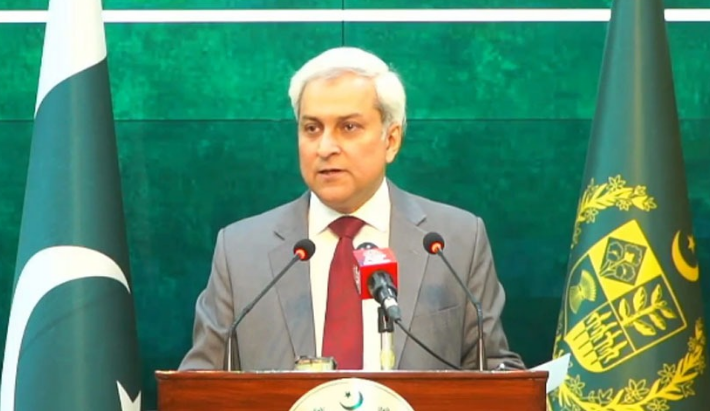
During his weekly media briefing in Islamabad, Foreign Office (FO) Spokesperson Ambassador Tahir Andrabi said Pakistan had formally handed over a list of 257 Indian nationals imprisoned in the country to the Indian High Commission.
He noted that the step was taken under the framework of bilateral commitments between the two neighbours.
The FO spokesperson said that the exchange was conducted in accordance with the Consular Access Agreement signed on May 21, 2008, which obliges both countries to share prisoner lists twice every year.
He added that Islamabad and New Delhi also exchanged lists of their respective nuclear installations and facilities under the Agreement on the Prohibition of Attacks against Nuclear Installations and Facilities.
Signed on December 31, 1988, the agreement requires both sides to notify each other of nuclear sites covered by the accord on January 1 each year. In line with this requirement, Pakistan’s list was officially delivered to a representative of the Indian High Commission at the Ministry of Foreign Affairs.
Responding to a question about media reports suggesting India’s plans to build the Dulhasti Stage-II Hydroelectric Project on the Chenab River, Ambassador Andrabi said the reports were a matter of serious concern, as Pakistan had not been provided any prior information or formal notice regarding such a project.
He said these developments once again pointed to a disregard for international law and bilateral obligations.
The Pakistani Commissioner for Indus Waters, he added, has already sought detailed clarification from his Indian counterpart on the project’s scope, nature and technical aspects.
The FO spokesperson said that Pakistan also wants to determine whether the reported initiative involves a new run-of-the-river project, modifications to an existing facility, or additional construction work.
He stressed that under the Indus Waters Treaty, India cannot misuse its limited rights to unilaterally develop hydroelectric projects on the western rivers.
Andrabi further said that any such undertaking on the western rivers is subject to strict design criteria, operational limitations and mandatory information-sharing provisions.
Calling on India to return to full compliance with the Indus Waters Treaty, Ambassador Andrabi urged New Delhi to respond to the questions raised by Pakistan’s Indus Waters Commissioner in his recent and earlier communications.
Reaffirming Pakistan’s stance, he said that the Indus Waters Treaty remains a binding international agreement, noting that decisions by the Court of Arbitration in June and August last year had clearly upheld its validity. He emphasized that no unilateral move can alter this legal reality.
The spokesperson reiterated that Pakistan remains committed to resolving all disputes with India through peaceful means, but made it clear that the country would not compromise on the vital water rights of its people.
Replying to another question about the recent announcement by the US administration regarding arms sales to Taiwan, Ambassador Andrabi said Pakistan and China share an iron-clad friendship and an all-weather strategic cooperative partnership.
He said Pakistan has consistently supported China on matters relating to its core interests, including Taiwan.
He reaffirmed Pakistan’s firm adherence to the One-China policy and stated that Islamabad considers Taiwan an inseparable part of China.
The spokesperson urged all relevant countries to honour their historical commitments, contribute to peace, security and development in Taiwan and the wider region, and avoid actions that could heighten tensions or undermine regional stability.
Neo News | Copyright © 2026