Thu, September 17, 2026

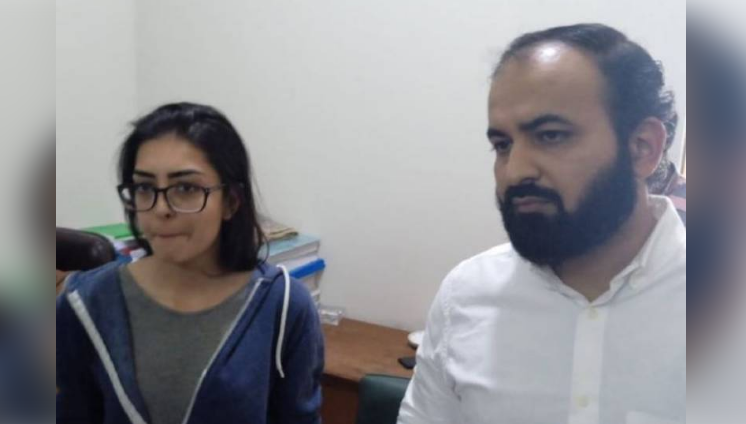
Islamabad (Web Desk): A district and sessions court in Islamabad on Friday directed authorities to arrest human rights lawyer Iman Mazari and her husband, Hadi Ali Chattha, within 24 hours over allegedly provocative social media posts.
Additional District and Sessions Judge Afzal Majoka expressed strong displeasure over the failure to execute previous arrest warrants.
The court’s order followed the cancellation of the couple’s bail on Thursday, after repeated absences from hearings and disorderly conduct during proceedings.
The judge instructed that the duo be immediately taken into custody and produced before the court, while also stripping them of the right to cross-examine witnesses.
The case has been registered under the Prevention of Electronic Crimes Act (PECA) of 2016. Prosecutors allege that Mazari and Chattha used social media to foment linguistic divisions and give the impression that state institutions were involved in acts of terrorism within Pakistan.
Islamabad Police Deputy Inspector General (DIG) Jawad Tariq, along with the DIG Operations and Syed Khurram Ali, director of the National Cyber Crime Investigation Agency (NCCIA), appeared in court.
Judge Majoka criticized the police for failing to execute the warrants, emphasizing that such lapses in the federal capital raised serious concerns.
The judge ordered that the accused must be arrested within 24 hours, whether they were in Pakistan, India, or Afghanistan, and whether on land, sea, or air. He insisted that compliance with the court’s orders was non-negotiable.
NCCIA director informed the court that a four-member team had been deployed, but the accused were not found at their registered addresses and appeared to be deliberately evading arrest.
Judge Majoka rebuked law enforcement, questioning how authorities could expect to make arrests in other provinces if they were unable to apprehend suspects in Islamabad, and reiterated that the warrants had to be carried out without delay.
The judge also criticized prosecutor Sheikh Aamir Suhail for not appearing in court and removed him from the case.
Directing the DIG Operations to ensure immediate enforcement, Judge Majoka ordered that the accused be produced before the court by 11am. The hearing was temporarily adjourned with a warning that contempt proceedings would follow if the orders were ignored.
When the court reconvened at 11am, Judge Majoka again questioned the prosecutor’s absence, reminding him that as a salaried officer, he was required to attend every NCCIA-related hearing.
Investigation Officer Imran Haider stated that the accused were currently absconding, which had hampered their arrest. NCCIA officials said teams had been deployed and requested until noon to carry out the operation.
The judge directed the DIG Operations to oversee strict compliance and assigned an SP-level officer to supervise the arrests, stressing that the accused were being given a 24-hour window for detention.
Mazari and Chattha, who are both prominent public figures, are accused of posting content on X, (formerly Twitter), which authorities have described as “anti-state.”
The NCCIA alleges that these posts were intended to sow division and portray state institutions in a negative light.
Earlier, the trial court had issued non-bailable arrest warrants after the couple failed to appear, which drew criticism and legal challenges from the defence. The couple subsequently approached the Islamabad High Court (IHC), claiming procedural irregularities and a lack of transparency, including the recording of evidence in their absence and without proper legal representation.
Their request to transfer the case was denied by the high court, after which they moved the Supreme Court (SC), which temporarily suspended proceedings until the high court concludes its review.
Meanwhile, the Islamabad Bar Association and other legal bodies have raised concerns that the defendants’ right to a fair trial is being undermined.
The case has experienced multiple adjournments and ongoing litigation in higher courts over issues of due process and the protection of defence rights.
Neo News | Copyright © 2026