Thu, September 17, 2026

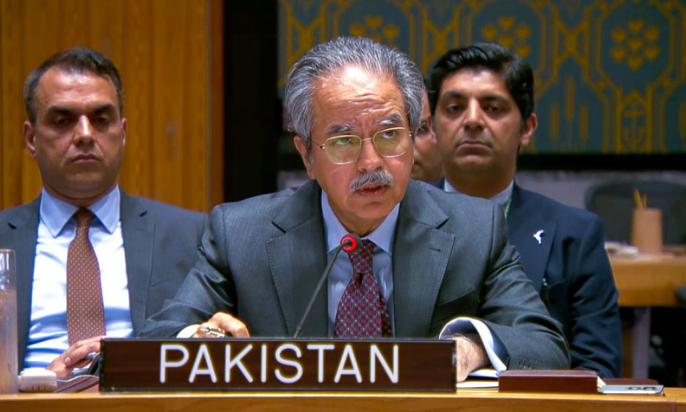
New York (Web Desk): Pakistan has told the United Nations Security Council (UNSC) that terrorist outfits, including the Tehreek-e-Taliban Pakistan (TTP) and other armed groups, continue to operate freely from Afghan territory, warning that Islamabad retains the right to respond in self-defence whenever necessary.
During a discussion on the worsening security situation in Afghanistan, Pakistan’s Permanent Representative to the UN, Ambassador Asim Iftikhar Ahmad, highlighted what he described as a sharp escalation in terrorist violence targeting Pakistan, much of it allegedly planned across the border and carried out using weapons left behind after the withdrawal of foreign forces.
“We will not sit idle while suffering from terrorist acts,” Ambassador Asim Iftikhar Ahmad, permanent representative of Pakistan to the UN, said during a 15-member Council debate on the deteriorating situation in Afghanistan on Monday.
He further stated that Pakistan would not tolerate continued cross-border militancy and reserved the right to protect its sovereignty, territorial integrity, and national security through appropriate action in accordance with international law.
“It is deplorable that the Taliban have reverted back to their old tactics of providing safe havens to terrorist groups and chosen the perilous path of complicity, backed by an outside actor, the historic spoiler and instigator of chaos, that has moved fast as an opportunist to wage a proxy war against Pakistan,” the Pakistani envoy said, in an obvious reference to India.
He reiterated that while Pakistan remains open to diplomatic engagement, its national security is non-negotiable and it will act against any threat directed at its territory.
“Pakistan will defend itself against whosoever attempts to harm our sovereignty, territorial integrity and national security.”
Ambassador Ahmad said Islamabad has repeatedly engaged with regional partners to encourage the Afghan authorities to act against militant networks, acknowledging the roles played by Qatar, Türkiye, Saudi Arabia, and China in facilitating dialogue efforts.
However, he accused the Afghan authorities of failing to take decisive action against groups such as the Balochistan Liberation Army and TTP.
“Yet,” he said, “the Taliban’s continued intransigence and even refusal to publicly denounce and condemn terrorist groups such as the TTP and Balochistan Liberation Army (BLA) is deeply disturbing — it is evidence enough of their complicity and active support for these groups”.
Ambassador Asim also reiterated Pakistan’s position that any response to aggression would be defensive in nature and fully consistent with international legal norms.
The Pakistani envoy criticised certain international reporting mechanisms, including those of the United Nations Assistance Mission in Afghanistan, arguing that they fail to fully reflect the cross-border dimensions of terrorism affecting Pakistan and overlook the broader security environment.
He also pointed to issues such as illicit financial flows, arms proliferation, and informal money transfer systems, which he said contribute to instability in the region. According to him, these factors, combined with governance failures, have worsened Afghanistan’s crisis.
“We must not lose sight of the fact that it is the Taliban’s reckless style of governance and flawed ideologies of extremism, suppression, and radicalization that have brought upon Afghanistan the calamities it faces today,” he
He added that humanitarian challenges in Afghanistan are being exacerbated by internal policy failures and mismanagement, particularly those affecting vulnerable populations.
Addressing the refugee issue, Asim said Pakistan has hosted millions of Afghan nationals for decades but stressed that such arrangements were never intended to be permanent. He also rejected the narrative that Afghanistan’s difficulties are driven by returning refugees.
“Shifting the blame of Afghanistan’s woes to the inflow of Afghan returnees will not solve the problem.”
He further said that Pakistan and Afghanistan share deep historical, cultural, and geographical bonds, but emphasized that instability in Afghanistan has had severe consequences for Pakistan as well.
“No country has suffered more from the consequences of conflict and instability in Afghanistan than Pakistan. So we understand, and we also know, that no country stands to benefit more from peace, prosperity and stability in Afghanistan than Pakistan.”
He warned that while there is still time for corrective action, the opportunity is shrinking.
“The window for course correction is narrowing, but is still open. We hope the Taliban realize this in earnest and cooperate with the international community for the long-term peace and development of Afghanistan and, above all, in the best interest of all Afghans.”
At the outset of the session, officials from United Nations Assistance Mission in Afghanistan briefed the Council on the deteriorating humanitarian and socio-economic situation.
One civil society representative described the situation as “gender apartheid” and warned of worsening rights conditions for women and girls.
She noted that under recent regulations, authorities have gone so far as “criminalizing even “women’s faces and voices,” she highlighting the Criminal Procedure Code of January 2026, which legalizes violence against women.
She further stated that the legal framework “divides society into “free” and “enslaved”, criminalizes same-sex sexual conduct and treats men as the primary legal authority.”
Another briefing described Afghanistan’s humanitarian crisis in stark terms, noting that “Afghanistan remains one of the world’s largest and most complex humanitarian crises.”
Officials added that “Nearly half the country’s population needs help, driven by insecurity, economic fragility, climate shocks and restrictions on women and girls,” while warning that “Already struggling families were pushed even closer to the edge,” and that “Hunger is growing across Afghanistan,” as economic and security conditions continue to deteriorate.
The meeting underscored rising tensions between Islamabad and Kabul, even as international stakeholders continue to urge sustained engagement to prevent further regional instability and humanitarian collapse.
Neo News | Copyright © 2026