Thu, September 17, 2026

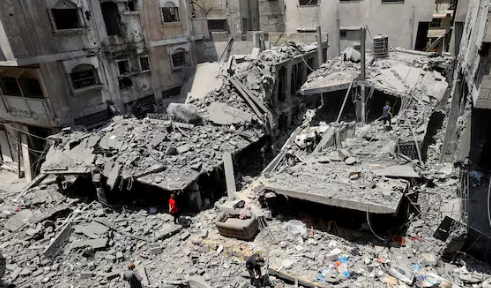
Jerusalem (Web Desk): Israel has approved a new military strategy to seize Gaza City, a move that has triggered immediate backlash both within the country and from the international community.
The plan, greenlit by Prime Minister Benjamin Netanyahu's security cabinet, comes as the conflict in Gaza approaches its second year, with rising pressure on Israel to agree to a ceasefire that could relieve severe humanitarian suffering and lead to the release of remaining hostages.
Netanyahu’s government outlined its intentions to expand military operations in Gaza with the goal of defeating Hamas, stating that the Israeli military would assume control over Gaza City while simultaneously facilitating the distribution of aid to civilians outside combat zones.
According to the prime minister’s office, the broader framework includes five guiding principles, which feature the demilitarization of the territory and the formation of a new administrative body—one that would not involve either Hamas or the Palestinian Authority.
In a recent interview with Fox News, Netanyahu clarified that Israel has no interest in governing Gaza long-term. Instead, he proposed the establishment of a security buffer and the eventual transfer of local governance to Arab entities capable of managing the region without posing a threat to Israel’s safety.
However, this shift in strategy has been met with significant criticism. Opposition leader Yair Lapid labeled the plan catastrophic, warning it could escalate tensions, put hostages at greater risk, and further damage Israel's standing internationally.
Families of hostages were equally vocal, accusing the government of abandoning their loved ones still held captive in Gaza. Of the 251 hostages taken during the 2023 Hamas-led attack on Israel, 49 remain unaccounted for—27 of whom are believed to be dead.
Israeli forces already claim to have control over roughly three-quarters of the Gaza Strip, mostly along its borders. Still, residents within Gaza are bracing for further violence.
Many are disoriented by ongoing evacuation orders, which have sent them repeatedly fleeing between northern and southern parts of the enclave. "They tell us to go south, then back north, now south again. We are human beings, but no one hears us," said Maysa al-Shanti, a mother of six.
The humanitarian crisis continues to deepen. According to the United Nations, Gaza requires a minimum of 600 aid trucks per day to meet basic needs.
However, only 70 to 80 trucks are currently getting through. The World Health Organization has recorded at least 99 deaths due to malnutrition this year, though officials warn the actual toll is likely higher.
The move by Israel has also strained relations with key international allies. Germany, traditionally one of Israel’s staunchest supporters, has taken the rare step of halting certain arms exports, citing concern that the equipment could be used in the Gaza operation.
German Chancellor Friedrich Merz said the latest Israeli plan fails to clarify how it would dismantle Hamas or facilitate the release of hostages, and described the situation as increasingly hard to justify.
Between October 2023 and May 2025, Germany authorized over €485 million in defense exports to Israel, including weapons, ammunition, and specialized military vehicles. The decision to freeze further shipments marks a notable shift in Germany’s approach to the conflict.
Condemnation has also come from Saudi Arabia, whose foreign ministry denounced the Israeli plan as a form of “starvation” and “ethnic cleansing,” accusing the Israeli military of committing egregious acts against the Palestinian population.
As per Gaza's Hamas-run health ministry, at least 61,258 Palestinians have died since the start of Israel’s offensive in 2023. In contrast, the 2023 Hamas attack on Israeli territory left 1,219 people dead, according to official Israeli sources.
As international alarm grows and diplomatic tensions rise, the future of Gaza—and of any lasting resolution—remains deeply uncertain.
Neo News | Copyright © 2026