Thu, September 17, 2026

By: Hirat Batool
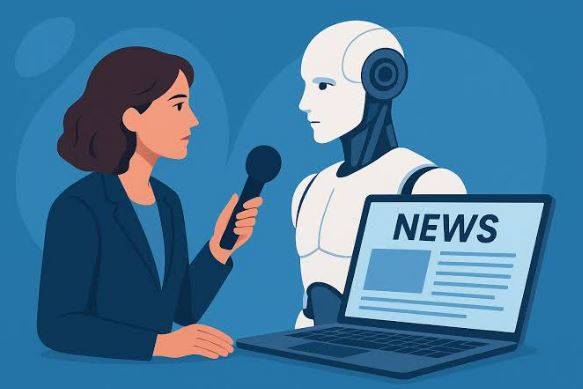
In today's world the newsroom has changed. Artificial intelligence is being widely used by media outlets worldwide. Within seconds, AI writes headline, reports, creates summaries and translates interviews and even generates animated news stories. The production and dissemination of the news are largely influenced by algorithms alongside reports and editors.
I attended a workshop under the project titled "Digital Trust and Free Expression in the AI Era," organized by the Department of Media and Development Communication, University of the Punjab, with the support of the U.S. Mission to Pakistan in collaboration with the Pakistan-U.S. Alumni Network (PUAN). The workshop was attended by several journalists, media students, researchers, and academics. The workshop explored one pressing question: Is Pakistan’s media industry prepared for the responsible use of AI for content creation? The debates and discussions during the workshop made one thing abundantly clear that artificial intelligence and its influence is growing faster than the media's ability to use it responsibly. Today, the challenge is more ethical and professional rather than simply being technological.
One dominant fear or narrative that dominates the public conversation around artificial intelligence is that it will replace the journalists. However, the emerging reality inside the newsroom gives a different picture than commonly perceived public narrative. Upon deeper look, AI is automating repetitive tasks such as transcribing interviews, finding better hooks and generating article summaries etc. These functions now performed by AI save valuable time, allowing journalists to focus effectively on reporting and analysis.
Nevertheless, automatic doesn't eliminate human judgement. Instead, it shifts where that judgement is needed. Several media professionals during the workshop acknowledged using AI to draft headlines. However, many participants emphasized that while these tools improve efficiency, if left unchecked an AI generated content may be misinterpreted. It usually comes from the fact that AI often prioritizes engagement over accuracy. Resultantly, without accurate human judgement it creates unnecessary sensationalism due to use of click bate language.
Therefore, the consensus among the journalists was straightforward that AI surely can generate content, but only human judgement can ensure its transparency, fairness and contextual accuracy
The key takeaways of the workshop came from the project lead Dr. Ayesha Ashfaq, highlighting the dangers of AI hallucinations. The biggest difference between the search engines and generative AI is that the former produces results retrieving the existing information and later predicts text based on patterns. It clearly implies that generative AI can confidently produce fake references, fabricated quotes, incorrect statistics and even fictional or non-existing events.
Such trends have already caused real-world problems such as lawyers submitting AI generated court cases that never existed. For journalists, such grave errors can lead to misinformation and sabotage the newsroom’s credibility.
Hence, it is evident that human judgement can't be entirely replaced by AI. According to Dr. Ayesha Ashfaq, AI should be used as a research assistant, not a source of truth. Every generated content e.g., fact, quiet, image or statistics must be verified through primary sources and independent reporting before publication. In a nutshell, AI can speed up the process of drafting and research but ethical reporting and fact checking remain the responsibility of journalists.
As AI is integrating into newsroom operations, a range of new professional roles are emerging to support its responsible usage. Soon, media organizations will hire AI content editors to review and refine AI-generated content: stories, fact-checking specialists. Such jobs will help in verifying the claims produced by AI systems. Verification journalists will assist to authenticate digital content such as images and videos. Newsrooms are also creating roles for AI policy and ethics advisors to establish guidelines for the responsible use of AI. Moreover, content quality supervisors are playing an integral role in ensuring that AI-assisted journalism meets editorial standards.
AI is changing the mode of working rather than eliminating journalism jobs altogether. It has changed the skills required to perform the journalists’ job today. For example, the journalists will likely spend more time verifying, contextualizing and investigating information and less time rewriting press releases. Journalists will put out more time and value in the operational aspect which machines independently cannot evaluate. In many ways, journalism is moving from content creation to content verification. Verification is becoming journalism's most valuable skill.
Pakistan's media industry is still in the early stages of adopting AI governance, with many news organizations lacking formal policies on the use and disclosure of AI-generated content. Resultantly journalists often make independent decisions regarding using AI tools which leads to inconsistent editorial standards.
Experts and professionals at the workshop warned that this gap is highly dangerous during elections, political crises, disasters, and other breaking news events. During such events deep fakes, synthetic media, and AI-driven disinformation can spread rapidly, spreading misinformation. All these factors underscore the urgent need for stronger AI literacy and newsroom guidelines.
To conclude the whole debate, the biggest take away is that critical thinking is the biggest asset of journalists today. The success in the AI era no longer depends on mastering multiple AI tools rather than having a strong grip over critical thinking, technological literature coupled with verification skills and ethical responsibility. The debate is no longer based on whether AI should be used or not but whether journalists are ready enough to use it responsibly and maintain public trust.
The views, thoughts, and opinions expressed in this blog are solely those of the author and do not necessarily reflect the official policy or position of the U.S. Mission to Pakistan or USEFP.
Neo News | Copyright © 2026